Common Cooling Tower Problems and How to Fix Them

Vivek Donga

October 27, 2025

10 min

Introduction

Cooling tower problems can lead to substantial inefficiencies in industrial systems, resulting in increased energy consumption and higher maintenance costs. When cooling towers fail to perform optimally, industries face operational challenges that impact not just equipment longevity but also overall system performance.

Traditional chemical treatments, which have been used to address issues such as scaling and corrosion, are being gradually replaced because they are less effective and more harmful to the environment.

Best practice recommendations now suggest non-chemical water treatment systems as a more sustainable and efficient solution.

By addressing these common issues without relying on harmful chemicals, industries can reduce maintenance costs, improve operational efficiency, and ensure more reliable cooling tower performance.

Key takeaways -

Traditional chemical treatments are increasingly seen as less effective, environmentally harmful, and a limiting factor in achieving water efficiency.

Higher COC directly converts to massive water, cost, and energy savings. Non-chemical systems consistently achieve 8-12 COC, doubling the efficiency of traditional chemical treatments (3-5 COC).

Understanding how cooling towers work is the foundation for preventing the top seven problems: Scaling, corrosion, biofilm, inefficiency, water wastage, inconsistent quality, and downtime.

Kashyap's Non-Chemical Water Treatment Technology is a proven solution that solves root causes, breaks through traditional COC limits, and provides significant operational and environmental ROI.

How Cooling Towers Work: The Foundation of Problem Prevention

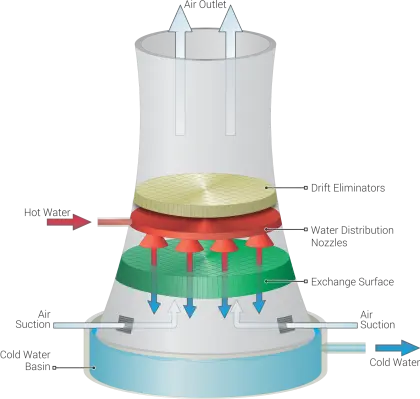
Cooling towers are designed to remove heat from water used in industrial systems. Here's a simple explanation of how they work :


Source - Mechanical-engineering.com


Heat Transfer

Warm water from industrial processes (like air conditioning or power plants) flows into the cooling tower.

The water needs to lose heat before it can be reused.

Evaporation Process

Inside the cooling tower, the warm water is spread across a surface (called fill media).

Fans draw air in, and as the water flows down, some of it evaporates. The evaporation process removes heat from the water.

Cooling Water Returns

The cooled water collects in a basin at the bottom and is pumped back into the system to absorb more heat.

This process is essential for keeping systems running efficiently. However, if issues like scaling, corrosion, or microbial growth occur, the tower's performance can drop, leading to higher energy use and maintenance costs.


Knowledge of cooling tower mechanics is the foundation for identifying, preventing, and fixing problems. Without understanding the "how," you're left reactive, struggling to fix issues without the right context. Effective problem prevention starts with solid knowledge. Only then can you maintain efficiency and longevity in the system....explains a leader in sustainable water technology and founder of Kashyap Non-Chemical Water Treatment Solutions!

Cooling Tower Cycles of Concentration: The Key to Water Efficiency

The cooling tower cycles of concentration (COC) play a crucial role in determining how efficiently a cooling tower operates.

This measurement, calculated as the ratio of dissolved solids in blowdown water compared to makeup water, directly determines your facility's water consumption, operating costs, and environmental impact.


The Formula of Water Savings

COC = Makeup Water Conductivity ÷ Blowdown Water Conductivity

Bleed and evaporative losses are offset by the addition of makeup water, So:


Makeup = Bleed + Evaporation Loss


1. Traditional chemical systems: Typically operate at 3-5 COC

2. Non-chemical water treatment systems: Achieve 8-12 COC consistently

3. Water savings calculation: 50% reduction in makeup water consumption when moving from 4 COC to 8 COC


How Does Traditional Chemical Treatment Limit COC Performance?

Most standard chemically treated cooling towers use unsoftened water and operate between 4 – 6 COC, depending on the source water quality, as documented by industry research.

This limitation exists because chemical treatments create their own scaling and fouling challenges at higher concentrations.


Non-Chemical Water Treatment Solutions: Breaking Through COC Problems

Kashyap's proven non-chemical water treatment solutions eliminate these traditional limitations through innovative physical water conditioning technologies.

Our systems have successfully enabled facilities to achieve 10-12 COC consistently while addressing common cooling tower issues that overrun conventional operations.


Benefits of Managing Cycles of Concentration with Non-Chemical Solutions:

  1. Enhanced Water Efficiency: Achieve higher cycles of concentration, reducing the need for fresh make-up water and decreasing waste.
  2. Cost Savings: Reduce the costs associated with water treatment chemicals and system maintenance.
  3. Environmental Impact: Minimise the use of harmful chemicals and contribute to sustainable industrial practices.


By implementing a non-chemical water treatment solution, you're not just improving your cooling tower's efficiency...you’re investing in the future of sustainable water management.

The Top 7 Critical Cooling Tower Problems and How to Fix Them?

Problem #1: Scale Buildup and Mineral Deposits

Scale forms when minerals in the water stick to pipes and equipment surfaces. This creates a layer that blocks heat transfer and slows down water flow.

Solution

Regular maintenance and water treatment can help prevent mineral build-up.

Using anti-scaling agents or improving water circulation are effective ways to reduce scale.

Monitoring water hardness and implementing proper water treatment is crucial to maintaining the system’s efficiency.


Problem #2: Corrosion of Metal Components

Corrosion is caused by an imbalance in water chemistry, usually related to pH levels, leading to rust and deterioration of metal components like pipes and cooling tower basins.

Solution

Maintaining the proper water chemistry is key.

pH adjustment, use of corrosion inhibitors, and regular cleaning of metal parts can prevent corrosion.

Regular inspections are necessary to catch any signs of deterioration early.


Problem #3: Microbial Growth and Biofilm Formation

Cooling towers can become breeding grounds for bacteria, algae, and fungi, which form biofilms that inhibit heat transfer, clog pipes, and reduce water quality.

Solution

Regular cleaning and disinfecting of the tower and water system, along with proper water filtration, can prevent microbial growth. Utilizing biocides or regular monitoring of water quality helps control microbial activity and biofilm formation.


Problem #4: Reduced Heat Transfer Efficiency

When scaling, corrosion, or biofilm formation occurs, heat transfer efficiency decreases, resulting in the cooling tower needing more energy to perform the same task.

Solution

Ensuring that the heat exchange surface is clear of obstructions and contaminants and that water is properly conditioned will help improve heat transfer efficiency.

Timely maintenance and monitoring of system performance are key to sustaining optimal function.


Problem #5: Water Wastage

Cooling towers are known to consume large amounts of water, and inefficient water management can lead to excessive water usage and increased operational costs.

Solution

Optimizing the cycles of concentration in the cooling tower helps to maximize water usage efficiency.

This involves controlling the amount of make-up water required and reducing water wastage, ensuring that the system operates sustainably.


Problem #6: Inconsistent Water Quality

Variations in water quality can lead to issues such as scaling, microbial growth, and corrosion, all of which affect cooling tower performance.

Solution

Regular water testing and maintaining consistent chemical levels are critical.

Ensuring balanced water parameters, like pH, alkalinity, and hardness, can help avoid performance issues.


Problem #7: Inefficient Maintenance and System Downtime

Reactive maintenance, rather than proactive monitoring and care, leads to frequent repairs and system shutdowns, which disrupt operations.

Solution

Establishing a comprehensive maintenance schedule and regular monitoring of system performance allows for early problem detection, reducing unscheduled downtime and costly repairs.

How Excellent Water Technology Can Help?

In addition to the solutions listed above, one of the best ways to address these common cooling tower issues is by opting to choose non-chemical over chemical water treatment.

For 21 years, Excellent Water Technology, with its non-chemical water treatment solutions named as anti-scale system and auto biofouling system (AUTO-BFSR) has been solving cooling tower problems that chemical treatments couldn't fix.

We are proud to have saved 50 million cubic meters of water, significantly contributing to global water conservation efforts. Our non-chemical water treatment solutions have also led to the reduction of 136.66 million kWh of energy, driving efficiency while lowering operational costs. Moreover, through our advanced technologies, we have helped eliminate 12.74 million tonnes of CO2 emissions, positively impacting the environment.

Having completed over 25,000 installations worldwide, we continue to deliver chemical-free, sustainable solutions that not only protect the planet but also improve the performance of industries across the globe!

FAQ's

1. What are the most common problems in cooling towers?

Cooling towers face issues like scaling, corrosion, bacterial growth, clogging, and poor water circulation, leading to reduced efficiency and maintenance problems.


2. Why does scaling occur in cooling towers, and how can it be prevented?

Scaling happens when minerals like calcium build up due to evaporation. Prevent it by using water treatment systems and regularly cleaning the cooling tower.


3. What causes corrosion in cooling towers?

Corrosion occurs when metal surfaces react with water, oxygen, and chemicals. It can be prevented with proper water treatment and regular inspections.


4. What is the best way to extend the lifespan of a cooling tower?

Regular maintenance, water treatment, cleaning, and monitoring for scaling and corrosion can significantly extend the lifespan of a cooling tower.

Conclusion - Making the Right Choice

These seven cooling tower problems require solutions that address root causes. While chemical treatments might provide temporary relief, they often create additional challenges, including environmental compliance issues, ongoing costs, and health risks.

Non-chemical water treatment solves these seven problems while meeting future regulations and sustainability requirements. Contact us today and start saving water, energy, the earth, and maintenance costs.


About the author

Vivek Donga

Vivek Donga is the CEO & Technical Director at Kashyap, a leading water solution company that provides solutions for hard water treatment. With 9+ years of experience in addressing hard water challenges and keeping the customer-centric approach, he is dedicated in delivering eco-friendly and efficient solutions for commercial and industrial applications.

Vivek Donga

CEO & Technical Director

Head Image

Get a Quote

Are you interested in our solutions?

India flag

(+91)

Please feel free to contact me directly

Image of head

Vivek Donga

CEO & Director (Technical)

info@ewt-kashyap.com
+91 97254 40807