October 28, 2025
19 min
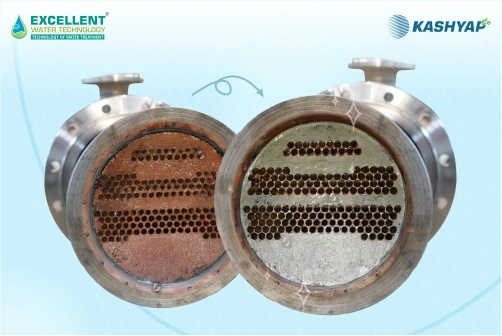
Condenser scale removal is a routine maintenance task that keeps cooling systems working properly. When water flows through condensers, minerals build up on surfaces over time. This buildup affects how well your system cools and uses more energy. Regular cleaning prevents problems and saves money on repairs.
There are different ways to clean condensers, from simple methods to advanced non-chemical descaling systems.
Understanding scale removal in condensers helps you choose the right approach for your needs. This blog explains what causes scale, why it matters, and how to remove it effectively!
✔ Even thin scale layers reduce heat transfer, raise energy use, and accelerate equipment wear.
✔ Main causes include hard water, high temperature, poor flow, evaporation, and system design flaws.
✔ Industrial removal uses mechanical descaling, chemical cleaning, or hybrid methods with strict safety protocols.
✔ Effective condenser scale prevention combines water softening, chemistry control, and advanced scale prevention technology.
✔ Prevention costs far less than reactive cleaning, delivering energy savings and extended condenser lifespan.
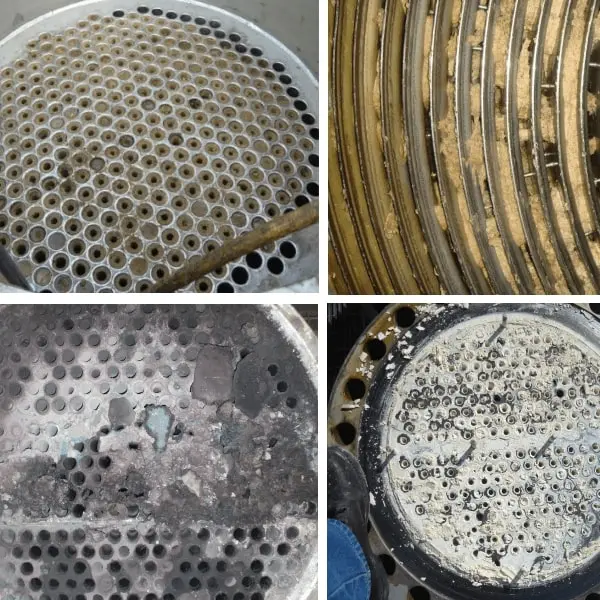
Scale formation in condensers refers to the buildup of hard, insoluble mineral deposits (such as calcium carbonate, magnesium hydroxide, silica) inside or on the surfaces of condenser tubes.
These minerals, carried by the cooling water, precipitate out and adhere to tube walls as water temperature or ion concentration changes, degrading heat transfer and flow.
1.Heat Transfer Efficiency Loss:
Scale deposits can decrease the efficiency of heat transfer, leading to higher energy consumption and increased operational costs. Even thin scale layers act as insulators, reducing cooling capacity at large.
2.Equipment Damage:
Scale build-up puts more heat stress on the metal itself, causing damage. The boiler tubes begin to absorb more of the heat instead of passing it through.
This increase in a boiler tube's temperature can cause it to reach its melting point, causing it to warp, bulge, and expand.
3.System Performance Issues:
Another performance issue that results from excessive condenser scale is a reduction in compressor capacity. As brake horsepower increases, compressor ratings decrease.
4.Flow Restrictions:
Scale buildup can restrict water flow, causing pressure drops and potential system failures. This forces pumps to work harder, increasing energy costs and wear.
5.Operational Costs:
Scale buildup silently erodes efficiency, increases operational costs, and shortens equipment lifespan. Systems with scale buildup can consume more energy than clean systems.
6.Premature Failure and Maintenance Downtime:
Over time, the stress, corrosion, and inefficiency can lead to leaks, tube failures, or forced shutdowns.
Also, severe scaling leads to unplanned shutdowns, emergency repairs, and expensive equipment replacement, disrupting critical operations.
In short, ignoring scale is a “slow killer” for condensers; it's not just reduced performance, but rising costs and risks.
Image Source - klarenbv.com
✔ Water Quality Issues
Hard water containing high concentrations of calcium, magnesium, and other minerals is the primary problem. The formation of scale deposits can significantly impact the efficiency of cooling systems, increase energy consumption, and lead to equipment failure.
✔ Temperature Variations
The scaling mechanism is the exceeding of the solubility limits of mineral substances due to high temperature and solids concentration at the tube/water interface. Higher temperatures reduce mineral solubility, accelerating precipitation.
✔ Evaporation Concentration
Evaporation in a boiler causes impurities to concentrate. This interferes with heat transfer and may cause hot spots. Continuous water loss through evaporation concentrates remaining minerals beyond saturation points.
✔ Water Flow Patterns
Low flow velocities and dead zones allow more time for mineral precipitation and deposit adhesion on surfaces requiring condenser tube cleaning.
✔ System Design Factors
Poor water distribution, inadequate filtration, and improper blowdown rates contribute to scale formation in condensers.
✔ Contaminated Condensate
If not properly monitored or treated, contaminated condensate water can contribute to scale in the system.
When scale has already formed inside condenser tubes or shell‐and‐tube units, the challenge is to remove it efficiently without damaging the equipment or causing any interruption during the process :
1. Mechanical / Physical Descaling
What it is: Use of brushes, scrapers, high‐pressure water jets, or specialized mechanical tools to physically dislodge and remove scale.
Common techniques:
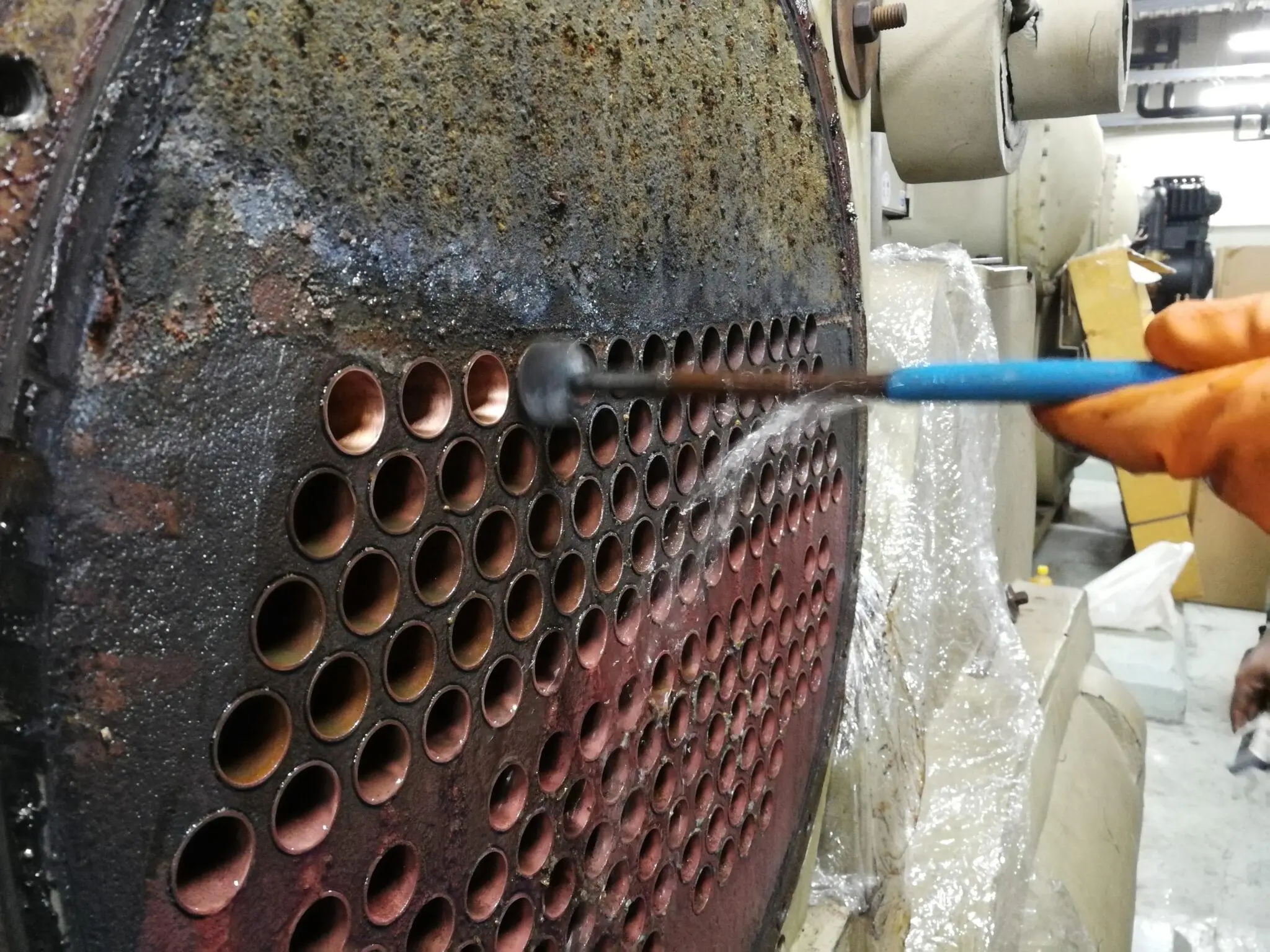
✔ Rotary tube cleaning (shaft + brush): A flexible shaft with a brush or scraper head is inserted into the condenser or heat exchanger tubes. As it spins, its scrubs scale off the walls, while the circulation of water flushes loosened debris downstream.
✔ High-pressure water jetting: A high-pressure (or ultra-high-pressure) water jet is directed along the tube wall to blast away scale. Good for soft to moderate scale, or to finish off after chemical softening.
✔ Tube cleaning projectiles / “bombs”: Some systems use small projectiles or balls that are carried through the tubes by fluid flow, scraping away deposits as they pass.
✔ Scraper tools/pigging: In shell-side passages or large bore regions, mechanical scrapers (pigs) or brushes can be run across surfaces to strip off deposits.
Image Source - klarenbv.com
2. Chemical Descaling / Acid Cleaning
What it is: Circulation of a descaling (acidic or specialty) chemical solution through the condenser to dissolve scale (especially calcium carbonate, magnesium compounds, etc.).
Typical procedure:
✔ Isolate the condenser and drain or neutralize residual coolants.
✔ Fill or circulate the descaling solution (often an inhibited acid or specialized formulation) through the tube side or shell side, depending on design.
✔ Allow sufficient dwell time (several hours to 24+ hours) for the scale to soften or dissolve.
✔ Agitate or recirculate if possible to assist penetration.
✔ After treatment, flush thoroughly with clean water to remove all residual chemicals and loosened solids.
✔ Neutralize effluent and treat spent acid as per environmental / permit guidelines.
Typical chemistries used:
✔ Inhibited hydrochloric acid (commonly used for carbonate scale) — often chosen with corrosion inhibitors to protect metal.
✔ Organic acid blends / chelating acid-based descalers (less aggressive, safer for some alloy metals).
✔ Specialty scale removal formulations (e.g., STSR or industrial descalers) are designed for industrial use to balance effectiveness and material safety.
Combined / Hybrid Methods (Chemical + Mechanical)
A very common industrial approach is a hybrid method: First, chemical softening/dissolution, then mechanical brushing or water jetting to remove softened scale, followed by flushing.
Strong safety protocols are non-negotiable. Below are best practices and guidelines used in industrial settings to protect people, equipment, and the environment.
Pre‐work Planning & Risk Assessment
1. Conduct a formal risk assessment
Before any work begins, the team should identify all hazards and define controls.
2. Review Material Safety Data Sheets (MSDS / SDS) for all chemicals
All personnel must know the hazards (corrosivity, toxicity, fumes) and first‐aid / spill response instructions from the SDS.
3. Check equipment compatibility and integrity
Ensure pumps, hoses, gaskets, and connections are rated for the chemicals, temperature, and pressure used.
Inspect for leaks, cracks, or wear in piping and containment systems.
Use proper fittings, clamps, and restraints so hoses or lines cannot whip or rupture.
4. Isolate and lock out / tag out (LOTO) systems
Fully isolate the condenser from the rest of the process lines.
Depressurize and drain residual fluids.
Lock out valves, electrical drives, and any potential energy sources.
Ensure valves, lines, and instrumentation outside the treatment zone are not accidentally exposed.
5. Plan for debris/solids handling
Scale removal will generate particulate debris (loosened scale).
Plan how to collect, filter, or trap solids to avoid downstream clogging or damage to pumps and valves.
6. Ventilation & gas monitoring
If chemicals release fumes (e.g, acid vapors, CO₂, H₂S), ensure adequate ventilation, gas detection, or continuous monitoring in the work area.
Personal Protective Equipment (PPE) & Safe Work Practices
✔ PPE is your last line of defense. Use it correctly and consistently.
✔ Chemical-resistant gloves, sleeves, and aprons rated for acids or cleaning agents in use.
✔ Full face shield + safety goggles (to protect eyes from splash and side exposure).
✔ Respiratory protection (e.g., acid gas cartridges or supplied air) if vapors/aerosols are hazardous.
✔ Chemical-resistant boots (steel toe recommended).
✔ Coveralls or full-body suits resistant to splashes.
✔ Hearing protection when using high-pressure water jets, mechanical tools, or noisy equipment.
✔ Train workers in the correct donning/doffing of PPE, decontamination, and inspection.
Confined Space & Accessibility Protocols
✔ Many condensers or tube bundles require entering tight, enclosed spaces.
✔ Treat any entry as a confined space if applicable. Follow entry permit procedures, atmospheric testing (O₂, toxic gases, flammables), rescue readiness, and communication.
✔ Ensure continuous gas monitoring inside the space.
✔ Provide a dedicated attendant/observer outside.
✔ Maintain proper lighting, communication devices, and ventilation blowers.
✔ Use explosion‐proof lighting and equipment if flammable gases may be present.
Monitoring, Inspection & Post-Work Checks
✔ Continuously monitor pressure, flow, temperature, chemical concentrations, and system integrity.
✔ Inspect for leaks, corrosion, or unexpected color/odour changes.
✔ After completion, thoroughly flush and neutralize all systems.
✔ Inspect all surfaces for residual chemical or scale.
✔ Decontaminate and clean all tools, hoses, and work areas.
✔ Perform audits, record incidents, and update safety procedures for future jobs.
Step 1: Pretreat Make-up Water & Softening
Start by reducing hardness in the incoming (make-up) water. Use ion exchange softeners, reverse osmosis, or dedicated softening units to lower calcium and magnesium levels.
Step 2: Control Water Chemistry & Operating Parameters
Maintain optimal pH, alkalinity, and conductivity levels in the circulating water. High pH or high alkalinity promotes carbonate precipitation.
Operate within safe temperature ranges. Higher water temperatures reduce the solubility of minerals.
Limit cycles of concentration (i.e., don’t let dissolved minerals build up too much). Use blowdown / bleed to purge excess mineral load.
Monitor key parameters (Ca²⁺, Mg²⁺, TDS, pH, alkalinity) regularly and adjust.
Step 3: Use Scale Inhibitors / Anti-scalants
Add small, controlled doses of scale inhibitors (also called antiscalants or dispersants). These chemicals prevent crystals from sticking or growing on surfaces.
Step 4: Filter / Remove Suspended Solids & Particulates
Use filters, strainers, sediment separators, or cyclonic separators upstream to remove suspended solids or particulate matter.
Step 5: Employ Scale Prevention Technology
5.1 Anti-Scale Removal System :
This is a non-chemical technology that alters the physical properties of dissolved minerals such as calcium and magnesium.
Instead of letting them crystallize and attach to the condenser tube walls, the system encourages minerals to form into stable, microscopic crystals that remain suspended in the water and are carried away.
Because the minerals no longer stick to surfaces, hard deposits don’t form, and existing scale layers often begin to break down naturally.
5.2 Auto Biofouling Scale Removal System (Auto-BFSR)
Biofouling (slime, algae, and microbial films) often works hand-in-hand with mineral scaling, making deposits harder to remove.
Auto-BFSR is designed to automatically clean and control both scale and biological growth without relying on continuous chemical dosing.
It uses a combination of physical processes (such as controlled turbulence, surface conditioning, or advanced pulse/wave action) to prevent the adhesion of both mineral scale and biofilms on condenser tubes.
5.3 Template Assisted Crystallization (TAC)
This or similar technologies convert dissolved hardness into harmless micro-crystals rather than depositing them on the metal. (This is one of the chemical-free methods promoted commercially.)
Step 6: Electromagnetic/Magnetic/Electronic Anti-scaling Devices
Though their effectiveness must be verified in industrial settings. Some studies examine anti-scaling devices for condensers.
Step 7: Routine Monitoring & Predictive Maintenance
Set up a schedule to test and inspect: water chemistry, pressure drop, heat transfer performance, and condenser tube inspection.
The bottom line: Investing in scale prevention technology and condenser scale prevention programs costs far less than dealing with scale problems after they develop.
| Factor | Cost of Scale Buildup | Cost of Scale Prevention |
| Energy efficiency | Scales as thin as 1/16 inch can increase energy consumption by 10–15%, driving up utility bills. | Prevention maintains clean surfaces, ensuring optimal energy transfer and lower operating costs. |
| Maintenance & cleaning | Frequent shutdowns, chemical descaling, or mechanical cleaning lead to high labor and material costs. | Preventive measures (softening, filtration, scale prevention technology) reduce downtime and cleaning frequency. |
| Equipment lifespan | Corrosion under deposits and overheating can shorten condenser life, requiring expensive repairs or early replacement. | Prevention protects metal surfaces, extending equipment lifespan and deferring capital expenditure. |
| Unplanned interruption | Unexpected failures cause production loss, delays, and lost revenue opportunities. | Prevention allows planned maintenance with minimal disruption to operations. |
| Environmental costs | Chemical disposal, wastewater treatment, and potential fines add extra expenses. | Chemical disposal, wastewater treatment, and potential fines add extra expenses. |
| Overall ROI | Reactive cleaning is costly, unpredictable, and recurring. | Prevention is predictable, cost-effective, and sustainable, delivering long-term savings. |
In short, Prevention is always cheaper than a cure. Investing in scale prevention technology pays back quickly through energy savings, reduced interruptions, and longer equipment life.
1. Kashyap Auto-BFSR (Biofouling Scale Removal) System
The Auto-BFSR system represents a breakthrough in water treatment, utilizing IoT-enabled electrochemical technology to simultaneously address scaling and biofouling challenges.
The system operates through controlled electrolysis, where water is processed in a dedicated electrochemical chamber. Direct current (DC) applied between electrodes initiates water electrolysis, creating distinct chemical zones. It is fully automated, affordable, easy to install, and offers real-time conductivity and TDS monitoring.
2. Kashyap Anti-Scale System
Complementing the electrochemical approach, the Anti-Scale system employs advanced microprocessor-controlled impulse technology to prevent scale deposits and remove existing deposits.
The system generates precisely calibrated electronic impulses that modify the crystallization behavior of calcium minerals in water. This process transforms calcium bicarbonate into non-adhesive calcium carbonate crystals that remain suspended and are easily washed away, preventing surface deposition. This technology saves water and, planet, and is a super effective non-chemical option to treat water.
1.What is scale in a condenser and why does it form?
Scale in a condenser is a hard, insulating deposit of precipitated minerals, primarily calcium carbonate (limescale).
Scale formation is caused by the supersaturation of minerals (often referred to as hard water) in the condenser's cooling water system. As water evaporates in the cooling process, dissolved solids like calcium and magnesium are left behind.
2.How do I know if my condenser has scale build-up?
The most reliable signs of scale build-up are those that indicate a loss of heat transfer efficiency:
High Head Pressure: The refrigerant condensing pressure is abnormally high.
Increased Energy Consumption: The compressor runs harder and longer, leading to a noticeable spike in utility bills.
Reduced Cooling Capacity: The entire system struggles to meet the cooling load.
3.What happens if I don’t remove the scale from a condenser?
If you do not remove condenser scale, you face a rapid decline in performance and lifespan:
Drastic Efficiency Loss: Scale acts as an insulator, greatly reducing the condenser's ability to reject heat.
Higher Operating Costs: The compressor works harder, wasting significant amounts of energy.
Equipment Failure Risk: The sustained high pressure and temperature can lead to tube leaks, under-deposit corrosion, or compressor burnout.
4.Can I clean the condenser scale without using chemicals?
Yes, you can clean condenser scale without relying on harsh chemicals.
5.What are non-chemical solutions for condenser scale?
Non-chemical solutions for condenser scale primarily use mechanical cleaning or physical water treatment methods to manage mineral deposits.
For continuous prevention, systems like an anti-scale removal system or auto auto-biofouling scale removal system utilize technologies like electrolysis to condition the water, preventing scale and biofouling without the need for traditional chemicals.
Scale buildup directly damages condensers' performance and costs you money through higher energy bills and potential interruptions. You now understand the causes and have the cleaning methods to act.
Stop the cycle of chemical cleaning and scale damage. Excellent Water Technology provides a permanent solution with its innovations, Kashyap's non-chemical water treatment solutions. It protects your equipment without chemicals(and has many more benefits).
See how it works for your specific system. Get in touch with our team for your custom recommendation!

Get a Quote
Are you interested in our solutions?
Please feel free to contact me directly

Vivek Donga
CEO & Director (Technical)
Response within 24 hours
Mon-Fri 9:00 - 17:00