September 15, 2025
9 min
What if you could run your cooling system without chemicals, save thousands on costs, and help the planet at the same time? Sounds too good? But that’s exactly what non-chemical water treatment is doing for industries worldwide. Instead of chemical dosing and wasted water, it delivers cleaner pipes, lower bills, and eco-friendly operations.
From hotels to hospitals, companies are already proving it works. In this blog, we’ll show you how this shift brings both economic and environmental wins and why sticking with chemicals might be costing you more than you think.
Let’s get into the details!
✔ Non-chemical systems eliminate chemical purchase costs and stabilise long-term operating budgets.
✔ Cooling towers can save up to 80–85% water through reduced blowdown cycles.
✔ Lower scaling and corrosion extend equipment life and reduce waste generation.
✔ Eliminating chemicals cuts CO₂ emissions and improves workplace safety.
✔ Non-chemical solutions strengthen ESG reporting and simplify compliance across industries.
Non-chemical water treatment is a method that prevents scale, biofouling, algae growth and corrosion(rust) in water/piping systems without the use of chemicals.
Instead, it relies on technologies like electronic impulses or electrolysis to alter minerals in water, keeping pipes and cooling towers clean, efficient, and eco-friendly.
Traditional water treatment depends on chemical dosing to control hardness, scale, and bacterial growth. While effective, it comes with recurring costs, hazardous waste, and environmental risks!
1. Elimination of Chemical Purchase Costs
Traditional water treatment relies on biocides, inhibitors, and softening salts. These chemicals not only cost money but are subject to unpredictable global price fluctuations. By eliminating them, operating budgets become more stable.
According to the U.S. Department of Energy, chemical treatment can account for up to 20% of cooling tower OPEX. Non-chemical systems remove this recurring expense entirely.
2. Reduction in Water and Energy Bills
Scaling reduces heat transfer efficiency, forcing pumps, chillers, and cooling towers to work harder. When deposits are controlled electronically or through electrolysis, both water and energy consumption drop.
✔ WHO highlights that cooling towers can contribute a major portion of total industrial water use.
✔ By cutting blowdown cycles, non-chemical methods save a lot of blowdown water, directly lowering bills.
Kashyap's Auto-BFSR system works well here, as it continuously removes biofouling and scale without wasting water.
3. Extended Equipment Life and Lower Maintenance
When surfaces remain free of scaling and corrosion, heat exchangers, chillers, and pipelines last longer. This means fewer shutdowns, lower repair bills, and reduced manpower for cleaning.
Association of Water Technologies also summarises how scaling reduces heat-transfer efficiency and increases pumping power.
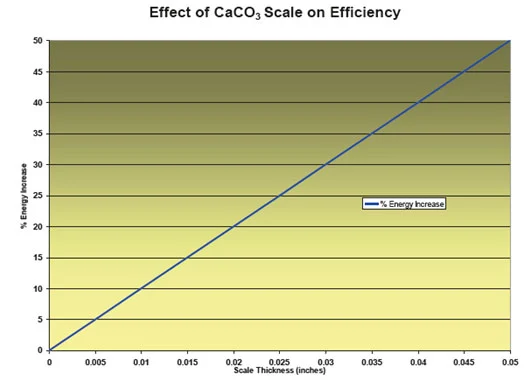
The effect of water hardness on heat transfer efficiency. As scale buildup increases inside pipes, the percentage of energy required to heat or cool water increases linearly.
Source - science-of-scaling
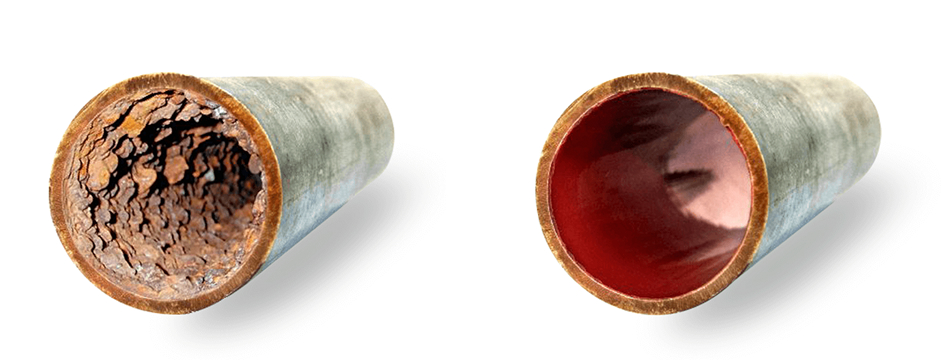
Kashyap's Anti-Scale System modifies calcium crystals to prevent them from sticking, which protects surfaces over the long term.
(Here is before/after image of a descaled outlet pipe that visually back the claim.)
4. Predictable Operating Expenditure
For sectors like hospitals, pharmaceuticals, and data centres, sudden cost spikes can disrupt annual budgets. Unlike chemicals, which fluctuate in price, a non-chemical system has fixed running costs.
This stability is an economic advantage because it allows organisations to plan and allocate funds with certainty. As business strategist Michael Porter famously said: “The essence of strategy is choosing what not to do.” Here, it’s about choosing not to be tied to volatile chemical costs.
5. Compliance and Risk Savings
Chemical treatment involves handling, storing, and disposing of dangerous substances. Each of these carries compliance costs and risks of penalties if mishandled. With non-chemical water treatment, these costs are eliminated.
The U.S. Environmental Protection Agency notes that chemical discharge from cooling towers is a major compliance issue across industries. Avoiding this reduces not only risk but also insurance and training costs.
6. Return on Investment (ROI)
Non-chemical systems usually achieve payback within 12–18 months, thanks to combined savings on chemicals, water, energy, and maintenance. After that, savings continue to accumulate year after year.
If you’re exploring solutions, Excellent Water Technology is not just a Water softening equipment supplier; we specialise in sustainable treatment technologies like the 'Anti-Scale System' and 'Auto-BFSR', which deliver these economic benefits in practice as shown above.
As environmental consciousness reaches critical mass globally, green water treatment solutions are revolutionizing how we approach water purification while safeguarding our planet's future.
1 Zero Chemical Discharge into Waste Streams
In many industries, cooling towers and water systems use chlorine and biocides. These chemicals end up in wastewater, which then needs extra treatment before discharge.
Non-chemical water treatment avoids this problem completely. It reduces the load on effluent treatment plants, lowers costs, and makes it easier to meet environmental rules.
For sectors like pharmaceuticals, food processing, and data centres, choosing green water treatment solutions means cleaner operations and smoother compliance reporting.
2 Major Reduction in Water Consumption
Water scarcity is among the world’s most pressing challenges. Non-chemical treatment reduces blowdown cycles and prevents scaling, resulting in savings of up to 80–85% of water in cooling towers.
This is a tangible contribution to water conservation, especially in regions already facing groundwater depletion.
In fact, the United Nations SDG Report 2023 emphasises that nearly 2 billion people live under water-stressed conditions. Organisations that prioritise efficient, chemical-free water treatment directly support the UN’s Sustainable Development Goal 6 (Clean Water and Sanitation).
3 Lower Carbon Footprint and Energy Demand
Eliminating the production, packaging, transportation, and storage of industrial chemicals significantly cuts down on associated CO₂ emissions. At the same time, when scale and biofouling are controlled naturally, equipment operates at higher efficiency, consuming less power.
The International Energy Agency estimates that improving industrial efficiency could cut global energy use by nearly 10% by 2030.
In this context, non-chemical methods act as a double win, reducing both direct emissions from chemicals and indirect emissions from wasted energy.
4 Credible ESG and Sustainability Credentials
Adopting chemical-free solutions provides organisations with a strong environmental narrative, which is increasingly valued in Environmental, Social, and Governance (ESG) reporting. PwC’s 2022 Global Investor Survey revealed that over 59% of investors are willing to divest from companies that fall short on ESG commitments.
This makes non-chemical treatment not only an ecological choice but also a reputational safeguard. For industries seeking to strengthen sustainability disclosures, showcasing investment in green water treatment solutions carries weight with both regulators and stakeholders.
5 Scalable Across Diverse Industries
From hospitals and food processing facilities to airports, data centres, and cold storage units, non-chemical methods adapt seamlessly across sectors.
This versatility makes them one of the most practical and widely applicable green water treatment solutions available.
For organisations looking to balance efficiency with sustainability, choosing the right water softening equipment supplier is key to long-term success. While our advanced systems like Auto-BFSR and Anti-Scale technology deliver these outcomes, the larger benefit lies in creating a standard for environmentally safe operations across industries.
Switching to non-chemical water treatment is no longer just about saving money, it’s about building safer, greener, and more predictable operations. From reducing water and energy use to eliminating chemical risks, the benefits are clear for industries that want efficiency with responsibility.
At Excellent Water Technology, we believe sustainability should go hand in hand with performance. That’s why we continue to develop solutions like the Anti-Scale System and Auto-BFSR that help organisations achieve measurable economic savings while protecting the planet.

Get a Quote
Are you interested in our solutions?
Please feel free to contact me directly

Vivek Donga
CEO & Director (Technical)
Response within 24 hours
Mon-Fri 9:00 - 17:00