How Electronic Descalers Prevent Scale Build-Up Without Using Chemicals

Vivek Donga

March 24, 2026

11 min

Table of Contents

Introduction

How-Electronic-Descalers-Prevent-Scale-Build-Up-Without-Using-Chemicals

A single millimetre of scale on a heat exchanger surface reduces thermal efficiency by up to 7.5%. Three millimetres? You are running your cooling system at a fraction of its designed capacity, burning electricity to compensate for losses that should never have existed.

The traditional response chemicals, descaling agents, and acid treatments solve the visible problem while creating invisible ones - corrosion risk, environmental liability, chemical procurement costs, and the operational dependency of a system that can't run clean on its own.

Electronic descalers offer a different approach entirely. This blog explains the science behind how they work, what they protect, and what to look for when choosing the one for your facility.

Key Takeaways

An electronic descaler uses electromagnetic or impulse-frequency signals to change the molecular shape of calcium and magnesium, preventing them from crystallising and sticking to surfaces.

They require zero chemicals, zero salt, and zero ongoing maintenance, making them the only truly passive water treatment technology.

Scale build-up reduces heat transfer efficiency by up to 40% for every 1mm of deposit. This directly impacts energy bills in industrial systems.

Kashyap's anti-scale system uses proprietary impulse frequency technology (3–32 kHz) to structurally alter hard water minerals at the molecular level.

What Causes Scale Build-Up in Water Systems

Scale forms when hard water carrying dissolved calcium and magnesium is exposed to heat, pressure changes, or evaporation. Under these conditions, the dissolved minerals stop behaving like part of the liquid. They crystallise, and they bond to metal surfaces. Over time, they harden into the chalky, insulating layer that causes scaling issues.

Hard water is not a water quality problem. It's a mineral behaviour problem. Scale build-up is what happens when that behaviour goes unmanaged inside your industrial system.

In cooling towers, the mechanism is particularly aggressive. The continuous cycle of evaporation concentrates the mineral content with every pass. Water that enters at a certain hardness level leaves at a fraction of the volume but carries the same mineral load. That concentration builds. Calcium carbonate precipitates. And it does so right where you least want it: on heat exchanger surfaces, in distribution pipes, across fill media, and along chiller tubes.

How Electronic Descalers Prevent Scale Build-Up Without Chemicals

The answer to this question is best understood through the problem itself.

Scale forms because calcium and magnesium ions in solution naturally cluster together and bond to surfaces when heat or evaporation changes the conditions around them. Electronic descalers intervene in that natural process before the bonding happens.

Here's the mechanism :

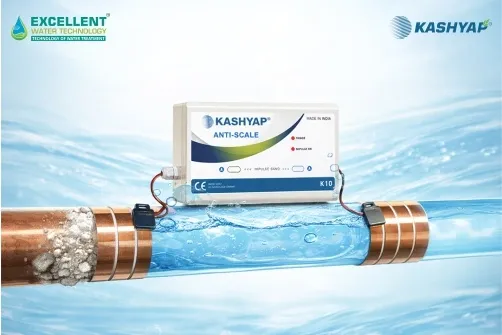
The electronic descaler wraps signal-transmitting bands or coils around the outside of an existing water pipe.

The device generates frequency-impulse signals (in the case of Kashyap's anti-scale system, proprietary impulse frequencies ranging from 3 to 32 kHz) that pass through the pipe wall and penetrate the water.

These signals alter the molecular shape of calcium and magnesium particles. Instead of forming their natural rod-like crystalline bonds that adhere to surfaces, the minerals restructure into forms that cannot bond; they remain suspended in the water and are carried through and flushed out with normal flow.

As a result?

A new scale cannot form on treated surfaces. Existing scale, now structurally disrupted by the altered mineral behaviour around it, gradually loosens and flushes away.

Ready to protect your heat exchangers and cooling systems from scale build-up?

Do Electronic Descalers Remove Hardness From Water

Electronic descalers do not remove minerals but change their crystallization behavior. While this approach reduces scale formation, it may not eliminate it. The effectiveness of electronic descalers can vary depending on the hardness level of the water and the specific technology used.

Benefits of Using an Electronic Descaler

1. 100% chemical cost elimination

There is no usage of acid dosing, descalling agents, chemical storage, disposal liability, or directly removing them from your water treatment budget.

2. 80% reduction in blowdown & makeup water

Less water is wasted maintaining concentration ratios. Significant savings on water consumption and effluent discharge in water-stressed regions.

3. Extended equipment lifespan

Pipes, chillers, heat exchangers, and cooling tower fill that would otherwise require chemical flushing or replacement every 3–5 years operate significantly longer.

4. Energy efficiency recovery

Every scale layer removed and prevented from re-forming restores heat transfer performance. In large cooling systems, this directly reduces compressor load and power draw.

5. Zero maintenance requirement

The system runs and reduces maintenance costs continuously from the point of installation. Without any salt refills, filter changes, or service visits.

6. Corrosion inhibition

Kashyap's impulse frequency technology triggers an electrophoresis effect, a protective metal-carbonate layer forms on internal pipe surfaces, inhibiting oxidation.

7. Biofouling prevention support

By eliminating scale deposits that serve as biofilm anchors, electronic water descaler reduce the surface conditions that support microbial growth, including Legionella-prone environments.

8. Environmental compliance

Having no chemical discharge, sodium loading of municipal wastewater, or reduced water consumption. Aligned with sustainability reporting and green certification frameworks.

Electronic Descaler vs Water Softener: What’s the Difference

FactorElectronic DescalerWater Softener
Primary functionPrevents scale formation by altering mineral behaviourRemoves calcium & magnesium via sodium ion exchange
Water hardness after treatmentWater hardness will be removedReduced — water is measurably softer
ChemicalsNoneSalt (ongoing), resin regeneration chemicals
Maintenance Zero - plug in and leave itRegular salt top-ups, resin servicing
Wastewater producedMinimal - 80% reduction in blowdownSignificant brine discharge during regeneration
Installation Non-invasive coils wrap around the existing pipeRequires an inline installation, dedicated drain
Best forCooling towers, heat exchangers, boilers, and industrial pipingDrinking water applications, textile, and certain pharma
Environmental friendlyExcellent zero chemical dischargePoor - high sodium brine into wastewater

The operational choice, especially for large-scale industrial cooling systems in India, consistently favours electronic descalers, not because water softeners don't work, but because water softeners were designed for a different problem set.

Are Electronic Descalers Really Effective

Yes. Electronic descalers are effective at preventing scale formation in water systems. The mechanism altering mineral crystallisation behaviour through electromagnetic or frequency-impulse energy is a documented physical process.

Studies in applied industrial water treatment have confirmed measurable reductions in scale accumulation across pipe systems, cooling equipment, and heat exchangers.

Switch to Kashyap’s Electronic Descaler for Chemical-Free Scale Control.

How to Choose the Right Electronic Descaler

The Right Questions to Ask:

1. Will this work on my pipe size and material — or is it rated for something smaller?

Most descaler manufacturers test on residential or light commercial pipe diameters. Your cooling tower mainline is not a 25mm household supply pipe. Before anything else, confirm the system is rated for your actual pipe diameter and that the signal transmission has been validated on the material running through your plant.

2. My water hardness is high. Will this actually hold up, or will I see scale by month three?

This is the question that separates impulse frequency technology from the cheaper magnetic clip-ons. A magnetic system has a fixed, passive field. When water hardness rises above a certain point, the field simply cannot keep up. An impulsive technology like Kashyap's continuously generates active frequency signals across a 3–32 kHz range, meaning it adapts to your water profile rather than being defeated by it.

3. I have existing scale build-up. Does this remove it, or only prevent new formation?

Both, but the timeline matters. An electronic descaler will gradually loosen and flush existing deposits as the altered mineral behaviour disrupts the structural bonds holding the scale to surfaces. For lightly scaled systems, this happens within weeks. For heavily scaled systems, particularly old heat exchanger tubes or boiler surfaces with years of deposits, a baseline inspection before installation is worth doing, so you can measure actual clearance progress over the first 60–90 days.

4. We have sustainability targets. Does this help or just not hurt?

It actively helps. Zero chemical discharge, 85% reduction in blowdown and makeup water consumption, lower energy draw from recovered heat transfer efficiency; these are reportable, quantifiable contributions to your facility's environmental performance. For plants under ISO 14001, green building certification, or internal ESG reporting, these numbers belong in your annual data.

FAQs

1. What is an electronic descaler, and how does it work?

It's a non-chemical device that uses electromagnetic fields to alter hardness minerals so they cannot form scale, keeping them suspended in the water.

2. Do electronic descalers remove hardness from water?

Yes. Electronic descalers remove hardness from water

3. What is the difference between an electronic descaler and a water softener?

A softener removes minerals using salt and creates waste. A descaler conditions minerals without removal and creates no waste.

4. Are electronic descalers really worth it?

For industrial applications seeking to avoid chemical handling, downtime, and environmental compliance issues, and need better long-term value and operational stability than electronic descalers are really worth it.

Conclusion

Scale is not an inconvenience in industrial water systems. It is a compounding operational liability that reduces energy efficiency, shortens equipment life, raises maintenance costs, and, in cooling tower environments, it creates the exact conditions that allow dangerous microbial growth to establish itself.

Electronic descalers address this at its root. Not by reacting to scale or by dissolving it with chemicals. But by preventing its formation entirely, changing how minerals behave before they ever reach a surface they should not be on.

Non-chemical water treatment is not the future of industrial water management. For facilities that have made the switch from TATA to Cipla to Siemens, it is already the present.

Excellent Water Technology has spent years engineering a system that fits exactly this need - the anti-scale system, built on impulse frequency technology, zero-maintenance operation, and a track record across some of India's largest and most demanding industrial environments.

About the author

Vivek Donga

Vivek Donga is the CEO & Technical Director at Kashyap, a leading water solution company that provides solutions for hard water treatment. With 9+ years of experience in addressing hard water challenges and keeping the customer-centric approach, he is dedicated in delivering eco-friendly and efficient solutions for commercial and industrial applications.

Vivek Donga

CEO & Technical Director

Contact our specialists now
Head Image

Get a Quote

Are you interested in our solutions?

India flag

(+91)

Please feel free to contact me directly

Image of head

Vivek Donga

CEO & Director (Technical)

info@ewt-kashyap.com
+91 97254 40807