March 13, 2026
13 min

Scale doesn't just hurt efficiency. It raises your electricity bill, shortens equipment life, and creates maintenance cycles that never quite end. For industries running 24/7 — pharmaceuticals, data centers, manufacturing, scale buildup in HVAC systems leads directly into operational risk.
The question is not whether scale is affecting your system. It almost certainly is. The question is how much it's costing you, and how quickly you can fix it. This blog answers both including the non-chemical solution for HVAC scale buildup trusted & implemented by leading companies.
✔ A scale as little as 1/32 inch increases fuel consumption by 2% in high-pressure systems, and losses reach 7%
✔ A single boiler with minimal scale can incur $70,000 in excess annual fuel costs
✔ Scale forces equipment to work harder, reducing lifespan and increasing maintenance frequency
✔ Under-deposit corrosion causes tube failures that chemical cleaning alone cannot prevent
✔ Chemical treatment requires ongoing purchases, generates waste, and demands handling precautions
✔ Non-chemical technology stops scale before it forms using impulse or electrolysis methods
✔ KASHYAP innovations achieve 100% chemical savings and up to 85% water reduction in cooling towers
✔ Switching to non-chemical prevention eliminates the recurring cost and environmental impact of chemical descaling
Scale buildup is the accumulation of dissolved minerals, primarily calcium carbonate, that precipitate out of water and adhere to internal surfaces of HVAC equipment. When hard water is heated or experiences pressure changes, these minerals lose their ability to remain dissolved and crystallize on pipes, heat exchangers, condenser tubes, and cooling tower fills.
Several factors contribute to scale buildup in HVAC systems:
✔ Water Hardness: Facilities drawing from borewell or municipal hard water sources face the highest risk. Calcium and magnesium concentrations determine how aggressively scale will form.
✔ Temperature Fluctuations: As water temperature rises, mineral solubility decreases. Heat exchangers, boilers, and condenser loops create perfect conditions for precipitation.
✔ Water Velocity: Low-flow areas allow minerals more time to settle and crystallize. This is why scale often appears first in dead-legs or during partial-load operation.
✔ pH Imbalance: Alkaline conditions accelerate calcium carbonate precipitation, while acidic water may cause corrosion alongside scaling.
✔ System Design: Older systems with larger diameter pipes experience different flow dynamics than modern high-efficiency equipment, often creating scaling hot-spots.
Scale appears wherever water carries minerals and experiences temperature change. Common locations include:
✔ Condensers and Chillers: The heat rejection side of refrigeration cycles concentrates minerals as water evaporates or temperature rises.
✔ Cooling Tower Fill: Evaporation leaves dissolved solids behind; these accumulate on fill media, restricting airflow and reducing heat rejection capacity .
✔ Boiler Tubes: High-temperature surfaces accelerate precipitation, creating the most severe efficiency losses.
✔ Piping and Valves: Inner diameter decreases as scale accumulates, restricting flow and increasing pumping pressure.
✔ Heat Exchanger Plates: Tight passages become clogged, reducing heat transfer efficiency and potentially causing complete blockages.
Scale buildup in HVAC systems acts as thermal insulation on heat transfer surfaces. Even 1 mm of deposit reduces efficiency by up to 40%, forcing compressors and pumps to consume more energy to deliver the same output, directly inflating operating costs.
Losing Thousands in Energy Waste?
✔ Increased Approach Temperature: A widening gap between the refrigerant and the water leaving the heat exchanger.
✔ Rising Energy Bills: Unexplained 10–15% spikes in monthly utility costs.
✔ Frequent High-Pressure Trips: The system shuts down because it cannot shed heat fast enough.
✔ Visible Crust: White, chalky deposits on cooling tower basins or nozzles.
The obvious cost is energy and it's substantial. But ignoring scale creates financial consequences:
Under-Deposit Corrosion
Scale traps moisture and contaminants against metal surfaces, creating localized corrosion cells that eat into tube walls. This leads to pinhole leaks, tube failures, and eventual equipment replacement.
Reduced Equipment Lifespan
Forced to work harder against insulating barriers, compressors, pumps, and fans wear prematurely. A well-maintained chiller might last 20-25 years; a scaled unit may fail in 10-15.
Production Losses
As the plastics manufacturer discovered, scale in process cooling directly impacts throughput and quality. When equipment can't perform at design capacity, revenue suffers.
Emergency Repairs
Unplanned shutdowns command premium labor rates and expedited shipping costs. They also disrupt facility operations, sometimes halting production entirely.
Chemical Treatment Escalation
More scale requires more aggressive chemicals, more frequent cleaning, and more downtime. It's a spiral that accelerates as deposits thicken.
Eliminate Hidden Costs with Kashyap's Technology
A proactive approach prevents the losses that reactive cleaning allows. Implement this checklist:
Daily
✔ Record approach temperatures on chillers and condensers
✔ Monitor cooling tower water temperature differentials
✔ Log pump discharge pressures
✔ Note any unusual cycling or operation patterns
Weekly
✔ Visually inspect the cooling tower fill for deposits
✔ Check strainers and filters for mineral accumulation
✔ Test water hardness and pH
✔ Document energy consumption against baseline
Monthly
✔ Compare current performance to historical data
✔ Inspect heat exchanger connections for leaks
✔ Review chemical treatment records (if using)
✔ Evaluate non-chemical treatment options
Quarterly
✔ Conduct thermal imaging of equipment during operation
✔ Perform non-destructive tube thickness testing
✔ Analyze trend data to predict future scaling rates
✔ Consult with water treatment specialists
Annually
✔ Comprehensive system inspection
✔ Compare energy costs against industry benchmarks
✔ Evaluate ROI of switching to non-chemical prevention
✔ Update maintenance protocols based on findings
Traditional methods rely on "sequestering agents" or acids. While effective at dissolving rock, they are aggressive toward copper pipes and harmful to the environment.
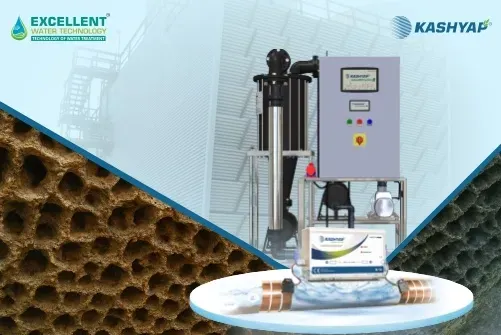
A non-chemical solution for scale or bacteria buildup (like Kashyap’s innovation AUTO BFSR) uses an electrolysis process to treat water. It changes the crystalline structure of the minerals so they cannot stick to the walls, keeping them in suspension until they are flushed away.
Kashyap’s approach to scale prevention represents a fundamental shift from traditional water treatment. Rather than adding chemicals to change water chemistry, our technology alters the physical behavior of minerals already present.
Kashyap's Anti-Scale System with Impulse Technology: This innovation generates specific electromagnetic impulses that travel through pipe walls into the water column. These impulses change the way dissolved minerals crystallize. Instead of forming hard, adherent scale (calcite), minerals precipitate as microscopic, non-adherent particles (aragonite) that remain suspended and flow harmlessly through the system.
Kashyap's AUTO BFSR with Electrolysis Technology: For cooling tower applications, KASHYAP AUTO BFSR (Biofouling and Scale Removal System) uses controlled electrolysis to produce oxidants that prevent both scaling and biological growth. This dual-action approach eliminates the need for biocides while achieving remarkable water savings.
The results speak for themselves:
✔ 100% chemical cost savings - without using softeners, descalers, or biocides to purchase
✔ Up to 85% reduction in blowdown and makeup water - conserving precious resource
✔ Inhibits corrosion - scale prevention also protects metal surfaces
✔ Maintenance-free operation - once installed, there's nothing to refill or replace
For facilities seeking to eliminate chemical handling, reduce water consumption, and protect assets permanently, non-chemical technology offers a path that reactive chemical treatment cannot match.
Deployed by: Tata, Adani, Siemens, Cipla, Aditya Birla Group, Finolex Pipes, JSW, Ultratech & more.
Want to reduce energy waste and extend HVAC equipment life?
1. How scale buildup affects HVAC efficiency?
It acts as an insulator on heat-exchange tubes. This prevents efficient heat transfer, forcing the compressor to work harder and consume more electricity to meet the cooling demand.
2. Can hard water damage my HVAC system?
Yes. Hard water leads to scale buildup in HVAC systems, which causes localized overheating, pipe clogging, and premature equipment failure due to under-deposit corrosion.
3. How do I know if my HVAC has scale buildup?
Monitor your approach temperatures and energy consumption. If the system requires more power to achieve the same cooling setpoint, HVAC scale problems are the likely cause.
4. Does scale buildup increase electricity bills?
Absolutely. Even a negligible 0.03-inch layer of scale can increase energy consumption by nearly 10%, leading to thousands of dollars in wasted operational spend.
Efficiency is the foundational requirement of industrial operations. Scale buildup in HVAC systems is an avoidable charge on your facility's performance. At Excellent Water Technology, we believe in a future where water treatment is clean, automated, and sustainable. By switching to a non-chemical solution for HVAC scale buildup, you protect your machinery, your budget, and the environment simultaneously. Don't just manage scale & bacteria, eliminate its ability to form.

Get a Quote
Are you interested in our solutions?
Please feel free to contact me directly

Vivek Donga
CEO & Director (Technical)
Response within 24 hours
Mon-Fri 9:00 - 17:00