How to Calculate Cooling Tower Efficiency?

Vivek Donga

December 17, 2025

18 min

Table of Contents

Introduction

Your cooling tower runs 24/7, but do you really know how well it's performing?

Whether you run a chemical plant, data centre, or manufacturing operation, knowing your cooling tower efficiency calculation helps you prevent costly losses and reduce energy waste.

The cooling tower efficiency formula involves measuring the range and approach temperatures to determine how effectively your system transfers heat.

This blog guides you through the complete cooling tower performance calculation process, explains the meaning of the numbers, and provides practical ways to improve efficiency when performance drops below acceptable levels.

Key-Takeaways

Cooling tower efficiency depends on the temperature range and approach, showing how effectively heat is removed from water.

Even a 5–10% drop in efficiency can raise energy costs, water use, and maintenance frequency significantly.

Major performance influencers include airflow, water quality, scaling, fouling, and ambient wet-bulb temperature conditions.

The formula - Efficiency = [Range ÷ (Range + Approach)] × 100 helps quantify real-world tower performance.

What Is Cooling Tower Efficiency?

Cooling tower efficiency is the percentage that shows how close your cooling tower gets to its theoretical best performance.

Let us understand in a better way.

Your cooling tower can never cool water below the wet-bulb temperature of the air around it. (That's a physical law)Water can't get colder than the air's saturation temperature through evaporation. So when we measure efficiency, we're comparing the actual cooling you're getting against this theoretical limit.

Simply, efficiency = amount of temperature drop achieved / how close you could ideally get (based on ambient wet-bulb). A perfectly efficient tower would bring water down exactly to the ambient wet-bulb temperature; however, in practice, you always fall short due to losses, fouling, airflow limitations, and other factors.

If your cooling tower is more efficient, you use less electricity, waste less water, and your equipment downstream works in more favorable conditions. Efficiency becomes a practical yardstick for performance, not just a theoretical concept.

Why Is It Important to Measure Efficiency?

Energy costs money. That's obvious. What's less obvious is how much money you lose when cooling tower efficiency drops by just 5-10%.

When your cooling tower efficiency falls, your chiller works harder to maintain process temperatures. That means higher compressor load, more electricity consumption, and bigger utility bills every month.

Water consumption increases, too. An inefficient tower needs more makeup water because you're running higher blowdown rates trying to prevent scaling that's already happening. In regions with water restrictions or high municipal water costs, this adds up fast.

There's also the equipment lifespan issue. When cooling towers lose efficiency, the entire HVAC system compensates. Chillers run longer cycles. Pumps work at higher pressures. Compressors overheat. These aren't designed to operate under continuous stress, and you'll see more frequent maintenance calls and earlier equipment replacement.

From a sustainability standpoint, efficiency measurement helps reduce water waste and environmental impact. When a tower operates at its optimal performance, it uses less makeup water, releases less blowdown, and keeps chemical consumption in check.

Monitoring efficiency also supports decision-making. Accurate data on cooling performance allows plant managers and engineers to plan maintenance schedules, allocate resources wisely, and justify system upgrades with clear evidence.

In short, measuring cooling tower efficiency ensures that your cooling tower runs cost-effectively, safely, and responsibly.

Key Parameters That Affect Cooling Tower Efficiency

Efficiency does not exist in a vacuum. It is impacted by a set of interconnected factors.

Below, we explore the main ones you must monitor and control:

Range

Range is simply the difference between the hot water entering the tower (HWT) and the cooled or “cold” water leaving it (CWT). It shows how much cooling the tower has achieved. Larger ranges (all else equal) help improve apparent efficiency.

Approach

The approach reveals how close the cooled water comes to the ambient wet bulb temperature (WBT). It is computed as (CWT – WBT).

The smaller the approach, the better your tower performs relative to environmental limits.

Wet Bulb Temperature (WBT)

This is the temperature reflecting the air humidity and ambient conditions.

Because cooling towers heavily depend on evaporation, they cannot cool water below the ambient wet bulb. Thus, a higher WBT (more humidity) automatically decreases achievable efficiency.

Airflow and Airside Conditions

How much air passes through your filter, the uniformity of that flow, and external wind patterns matter greatly.

Poor airflow increases resistance, reduces evaporation, and degrades performance.

Water Flow Rate / Circulation

If water moves too quickly, it doesn’t exchange heat well; if too slow, it can stagnate and encourage fouling. Proper balance is important.

Water Quality, Scaling & Fouling

Minerals, suspended solids, and biological films act as thermal resistances. Even a thin scale layer reduces heat transfer significantly.

Cycles of Concentration & Blowdown

As evaporation proceeds, minerals concentrate. You must blow down (discharge part of the water) to prevent scale.

But high blowdown wastes water; low blowdown causes scale. Managing this balance is necessary.

Ambient Conditions & Climate Variations

Temperature swings, heat waves, humidity changes, and seasonal shifts all impact how close to ideal your system can perform.

Fill Media Condition

It often gets ignored until problems become severe. Fill provides the surface area where water and air interact. Over months and years, UV light breaks down plastics. Biological growth clogs passages.

Scale deposits reduce the effective area. Physical damage from ice or debris creates uneven distribution. You can't see most of this deterioration from outside the tower, but efficiency measurements reveal it.

Water Quality

It impacts long-term efficiency more than anything else. Dissolved minerals cause scaling. Suspended solids clog distribution nozzles. Bacteria and algae create biofilms.

Corrosion products damage equipment. These problems develop gradually but compound each other scale provides surfaces for bacteria to attach, biofilms trap more minerals, and the cycle accelerates.

Our ‘Kashyap Anti-Scale System’ uses microprocessor-controlled electronic impulses to prevent scale from forming on surfaces in the first place.

Instead of fighting scale buildup with chemicals and accepting gradual efficiency loss, the system modifies calcium crystal structure so minerals stay suspended in water and wash through without depositing!

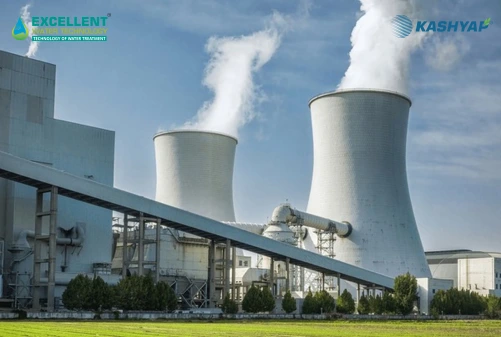
How to Calculate Cooling Tower Efficiency

The cooling tower efficiency formula is:

Efficiency (%) = [Range ÷ (Range + Approach)] × 100

To use this formula, you first need to calculate Range and Approach:

  1. Range = Hot Water Temperature - Cold Water Temperature
  2. Approach = Cold Water Temperature - Wet-Bulb Temperature

Let's understand the same with a real example so you can see exactly how this works.

Your cooling tower has these conditions:

Hot water entering: 95°F

Cold water leaving: 85°F

Ambient wet-bulb temperature: 78°F

Step 1: Calculate the Range

Range = 95°F - 85°F = 10°F

Step 2: Calculate the Approach

Approach = 85°F - 78°F = 7°F

Step 3: Calculate Efficiency

Efficiency = [10 ÷ (10 + 7)] × 100 Efficiency = [10 ÷ 17] × 100 Efficiency = 58.8%

Schedule a quick cooling tower performance review with our experts today.

What Is a Good Cooling Tower Efficiency?

Defining “good” depends on design parameters, climate, and operating conditions.

However, across industry references, a well-maintained cooling tower often achieves 60 % to 80 % efficiency under typical design conditions.

Efficiency between 70% and 75%

This range represents solid performance when the tower is well-maintained, properly designed for its heat load, and operating within its intended parameters. If your calculations consistently fall in this range, your tower is doing its job effectively.

Efficiency above 80%

This is excellent and suggests your tower is in top condition with minimal fouling, good airflow, and effective water distribution. Seeing efficiency in this range means your maintenance practices are working and your system design matches your application well.

NOTE - However, be cautious about measurements showing efficiency above 85% these might indicate measurement errors rather than exceptional performance, since physical limitations typically prevent evaporative cooling from achieving extremely high efficiencies.

Efficiency below 65%

This signals problems that need investigation.

Common causes include scale buildup restricting heat transfer, biofouling reducing fill effectiveness, inadequate airflow from dirty fan blades or failed motors, broken or collapsed fill media, or poor water distribution from clogged nozzles. When efficiency drops this low, operating costs rise significantly, and the risk of process cooling failures increases.

Different tower types show different efficiency ranges. Counterflow towers generally achieve slightly higher efficiency than crossflow designs because of better air-water contact patterns. Induced draft towers usually outperform forced draft configurations. Film fill provides higher efficiency than splash fill but is more susceptible to fouling in dirty water applications. Understanding your tower type's typical performance range helps set realistic expectations.

Good efficiency is as much about maintaining it over months/years as about hitting a high number today.

Common Issues That Reduce Efficiency

Scale Build-Up

Dissolved minerals (like calcium, magnesium, silica) precipitate and adhere to surfaces. Even a thin layer becomes a thermal barrier. Over time, this can reduce the effective heat transfer area.

Biofouling / Microbial Films

Algae, bacteria, slime, and biofilms grow in warm water circuits. These layers block direct contact between water and fill, trap solids, and create localized corrosion or hotspots. Biofilm control is harder than scale, yet vital.

Clogged Fill, Drift, or Louvers

Particles, debris, or sediment can block fill, degrade airflow distribution, or obstruct water distribution nozzles. Uneven airflow leads to hot spots and reduced evaporation.

Airflow Disruptions / Fan Failures

If fans slow, louvers deform, or airflow is nonuniform, the evaporation process weakens.

Excessive Blowdown or Poor Water Management

Too much blowdown wastes water and drives treatment costs; too little causes mineral concentration and scale. Misbalancing this hurts efficiency.

Uneven Water Distribution / Channeling

If water trickles preferentially through some zones, parts of the fill are underused, leading to inefficiency.

Thermal Short-Circuits or Recirculation of Heated Air

Warm air reentering the intake or poor tower placement can recirculate heat back into the tower.

Instrumentation Errors / Calibration Drift

If your temperature probes, thermometers, or psychrometers are miscalibrated, your efficiency numbers themselves become meaningless.

The Kashyap Auto-Biofouling Scale Removal System addresses several of these efficiency-robbing issues simultaneously through its electrolysis-based approach.

How to Improve Cooling Tower Efficiency

1. Regular cleaning and descaling

This practice removes the accumulated deposits that strangle efficiency. Physical cleaning removes sediment, biological growth, and loose scale from basins, fill media, and distribution systems.

For harder scale deposits, chemical cleaning with appropriate acids dissolves mineral buildup without damaging equipment.

The frequency of cleaning depends on water quality and operating conditions, but most facilities benefit from at least annual thorough cleaning with spot cleaning as needed throughout the year.

2. Optimizing water treatment

It helps prevent the common cooling tower problems that reduce efficiency in the first place.

Proper chemical treatment controls scale formation, corrosion, and biological growth. However, treatment programs need regular adjustment as makeup water quality, weather conditions, and operating parameters change. What worked perfectly in winter might be inadequate for summer conditions.

Modern approaches to water treatment increasingly favor non-chemical alternatives that eliminate the dosing inconsistencies and environmental concerns of traditional programs.

3. Installing advanced monitoring

This method will create a difference in the efficiency of the cooling tower from periodic crisis management to continuous optimization. Automated temperature monitoring, flow meters, and conductivity sensors provide real-time performance data that reveals trends before they become problems.

4. Balancing cycles of concentration

This method represents one of the most powerful levers for efficiency improvement, though it requires understanding the interplay between water conservation and equipment protection.

Operating at higher cycles reduces makeup water and blowdown, conserving water and energy.

5. Addressing system design

This becomes necessary when routine maintenance and treatment optimization no longer deliver acceptable performance.

Undersized towers, inefficient fill configurations, inadequate pump capacity, or poor piping design limit efficiency regardless of maintenance quality.

How Excellent Water Technology Helps Optimize Cooling Tower Efficiency?

Our approach to cooling tower optimization focuses on preventing the problems that degrade efficiency rather than constantly treating symptoms.

The Kashyap Anti-Scale System uses advanced microprocessor technology to generate electronic impulses that modify how calcium crystals form in water. Instead of allowing calcium to precipitate onto heat transfer surfaces where it acts as an insulator and reduces efficiency, the system transforms these crystals into a fine powder that washes harmlessly through the system. This proactive approach addresses scale formation at its source, maintaining clean heat transfer surfaces that operate at design efficiency.

For facilities dealing with both scaling and biological fouling, which often occur together since scale deposits provide surfaces for biofilm attachment - the Kashyap Auto-Biofouling Scale Removal System delivers comprehensive protection. Using electrolysis technology, the system precipitates calcium and magnesium minerals in a controlled chamber where they're automatically collected and removed.

By focusing on internal substrate protection and continuous fouling control, Excellent Water Technology helps your cooling towers stay closer to their ideal performance, not just when new, but across years of operation.

These sustainable solutions for cooling towers reduce environmental impact while improving operational efficiency.

FAQs

1. What is cooling tower efficiency in simple terms?

Cooling tower efficiency measures how closely the tower can cool the circulating water to the surrounding air's wet-bulb temperature (the theoretical minimum).

Higher efficiency means the water leaving the tower is significantly cooler, leading to better system performance and energy savings.

2. How often should I calculate cooling tower efficiency?

You should calculate cooling tower efficiency monthly or at least quarterly to track performance over time.

Regular monitoring helps detect drops in efficiency quickly, allowing for timely maintenance like cleaning or repairs before major operational issues arise.

3. How do you calculate the range and approach of a cooling tower?

The range is the difference between the hot water inlet temperature and the cold water outlet temperature.

The approach is the difference between the cold water outlet temperature and the wet-bulb temperature of the ambient air.

4. What is a blowdown in a cooling tower?

Blowdown is the controlled draining of a portion of the high mineral-concentration water from the cooling tower basin.

This process is necessary to prevent excessive build-up of dissolved solids, scale, and corrosion, which would otherwise significantly reduce the tower's efficiency and lifespan.

Taking Control of Your Cooling Tower's Performance

Understanding how to calculate cooling tower efficiency gives you the insight needed to manage these critical systems effectively.

Scale formation, biofouling, airflow restrictions, and mechanical issues all chip away at performance gradually. By the time efficiency drops noticeably, these problems have often progressed to the point where correction becomes more difficult and expensive.

The investment in proper efficiency management pays returns through lower utility costs, fewer emergency repairs, and the confidence that your cooling system will perform when you need it most.

About the author

Vivek Donga

Vivek Donga is the CEO & Technical Director at Kashyap, a leading water solution company that provides solutions for hard water treatment. With 9+ years of experience in addressing hard water challenges and keeping the customer-centric approach, he is dedicated in delivering eco-friendly and efficient solutions for commercial and industrial applications.

Vivek Donga

CEO & Technical Director

Contact our specialists now
Head Image

Get a Quote

Are you interested in our solutions?

India flag

(+91)

Please feel free to contact me directly

Image of head

Vivek Donga

CEO & Director (Technical)

info@ewt-kashyap.com
+91 97254 40807