Take a look at our blog's section that covers expert insights, industry trends, and strategies. Grow your knowledge and see what is happening in the industry.
Check out our case studies section and witness how we've helped businesses like yours achieve their goals. Real success stories backed with proven results.
7 Ways to Maintain Industrial Cooling Towers and Chillers
When industrial cooling tower maintenance is ignored, it quickly becomes one of the most concerned problem in the plant. Sudden trips and rising energy costs are usually the first signs that your heat transfer is failing.
This blog will talk about 7 practical ways that highlight industrial chiller maintenance so you can stop reacting to failures and start maintaining continuous production.
Key Takeaways
✔ Industrial chiller maintenance means clean condenser tubes and proper refrigerant charge.
✔ Chemical-free treatment can completely stop and remove corrosion, scale & fouling.
✔ Cooling tower and chiller maintenance works best when you combine preventive schedules with predictive data.
✔ Proper maintenance yields a 545% ROI by delaying huge capital replacements.
Think of your cooling tower and chiller as the circulatory system of your plant. If your heart or lungs fail, the body cannot operate. In an industrial environment, these systems are responsible for dissipating huge heat loads generated by manufacturing processes. When they are neglected, the outcomes are immediate and costly.
Proper maintenance is a must for operational reliability. It directly impacts your plant's ability to meet production targets. Unplanned downtime is the main problem, but the difficulty of inefficiency is just as dangerous.
A fouled condenser tube or a clogged cooling tower fill doesn't just stop the system; it forces it to work harder. This increases energy consumption, accelerates wear and tear on components like compressors and fans, and drastically shortens the effective lifespan of your equipment.
Furthermore, in regulated industries or critical environments like data centres, the reliability of these cooling systems is non-negotiable for safety and compliance.
Also, when they are maintained proactively, they naturally optimize energy efficiency of cooling towers. A clean tower with proper airflow and water distribution uses less energy to deliver the same cooling.
7 Ways to Ensure Proper Industrial Cooling Towers and Chillers Maintenance
1. Inspect and Clean Mechanical Components
Your system's mechanical heart fans, gearboxes, motors, and compressors demand constant attention.
For Cooling Towers: Regularly inspect fan blades for cracking, fraying, or changes in pitch. A damaged or misaligned blade can reduce airflow by 15-30% and waste energy. Ensure gearboxes are properly lubricated to prevent seizing. Check belts for tension and wear.
For Chillers: Monitor compressor operation for unusual vibrations or noises, which are early signs of failure. Use thermal imaging cameras to detect hot spots in electrical components and motor bearings
2. Understand Your Water Chemistry
This is the single most impactful yet frequently mismanaged aspect of cooling system care.
Poor water quality leads to scaling, fouling, and corrosion, which leads to the failure of the cooling system. Scale acts as an insulator, reducing heat transfer. Corrosion eats away at metal components from the inside out. Fouling from biological growth (like Legionella) clogs passages and creates hazardous conditions.
Regularly monitor and control key parameters like pH, conductivity, alkalinity, and hardness. The buildup of chloride ions, for instance, is a major factor driving the need for increased blowdown and bleed operations, wasting water and chemicals.
A cooling tower is only as efficient as its water distribution system. If water isn't spread evenly over the fill media, you create "dry spots" that drastically reduce heat transfer and can lead to fill collapse. During routine inspections (with fans off), observe the spray pattern from the nozzles. Clogged, broken, or misaligned nozzles are a common culprit.
Clean or replace them immediately to restore thermal performance and prevent long-term damage to the fill.
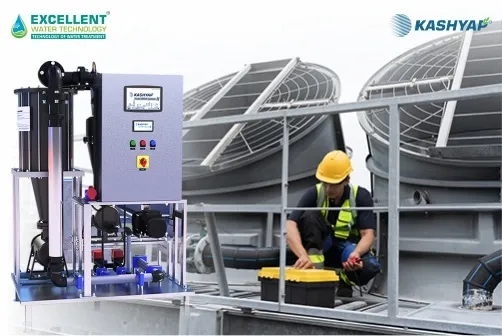
4. Integrate Kashyap's AUTO-BFSR Technology
Even with regular inspections, chemical dosing, blowdown control, and mechanical cleaning in place, cooling towers and chillers continue to face two persistent threats - mineral scale deposition and microbial biofouling.
Traditional chemical programmes may just work with symptoms. They do not eliminate the root cause.
Kashyap AUTO-BFSR (Auto Bio-Fouling & Scale Removal) works differently.
Instead of adding external chemicals, the system uses controlled electrolysis within the cooling circuit to:
✔ Convert dissolved salts into non-adherent particles
✔ Disrupt scale crystal formation
✔ Control biofilm development
✔ Reduce Legionella growth risk
✔ Maintain cleaner heat exchange surfaces
By continuously treating the circulating water, Kashyap's AUTO-BFSR stabilises heat transfer efficiency and reduces dependency on aggressive chemical dosing.
5. Inspect Fan and Motor Mechanical Integrity
Mechanical integrity is about ensuring the fan moves the maximum amount of air with the least amount of effort. If this connection is weak, you are paying for electricity that isn't cooling your water.
Vibration Analysis: Think of this as a pulse check. If a motor is shaking, the internal bearings are failing. Catching a vibration early allows for a cheap bearing swap instead of a total motor replacement.
Belts and Alignment: A loose belt slips and wastes energy; a belt that is too tight pulls the motor out of alignment and breaks the shaft. Both lead to a dead fan.
Lubrication: Friction creates heat. Proper greasing ensures the motor doesn't have to fight itself just to spin.
The "July" Rule: Motors fail when they are pushed the hardest. A seized fan in the summer heat is usually the result of ignoring a small vibration in the spring.
6. Lubricate and Align Rotating Equipment
Proper lubrication is the main pillar of rotating equipment. A poorly maintained gearbox in a cooling tower or a chiller compressor with inadequate oil will suffer from increased friction, leading to higher energy consumption and eventual seizure.
Furthermore, ensure that the motors to the fans are properly aligned. Misalignment generates destructive vibrations that loosen components, cause premature bearing failure, and can even lead to catastrophic structural damage.
7. Monitor the Condenser "Approach" Daily
This is the most accurate way to measure the health of your heat transfer. It is the temperature difference between the liquid refrigerant inside the chiller and the water leaving the condenser.
In a clean system, these two temperatures should be very close. This is called a "tight approach. As scale or biofilm builds up inside the tubes, it acts as insulation. This makes it harder for heat to move from the refrigerant to the water.
When you see the "Approach" number start to rise, it means your tubes are becoming fouled. The refrigerant has to get much hotter than the water just to force the heat through the gunk.
For every degree that the approach temperature rises, the compressor has to work harder, directly increasing your power consumption.
Maintenance-free cooling? Starts with Kashyap's AUTO BFSR
Water Chemistry Parameters That Impact Cooling Efficiency
To optimize your system, you must look beyond generalities and understand the specific chemical drivers of efficiency. These are the vital signs of your equipment's health.
pH Level: This measures how acidic or basic your water is. If the pH is too low (acidic), it accelerates corrosion. If it's too high (alkaline), it promotes scaling. Maintaining the correct pH range, as recommended by your water treatment specialist, is the first line of defence.
Conductivity: This measures the water's ability to conduct electricity, which is directly related to the concentration of dissolved salts (TDS). As water evaporates in a cooling tower, these salts concentrate. High conductivity indicates a high potential for scaling. This is the primary parameter used to control the blowdown process of bleeding off concentrated water to add fresh make-up water.
Calcium Hardness & Alkalinity: These two work together to form scale (calcium carbonate). Think of them as the building blocks of limescale. If the product of calcium and alkalinity exceeds the water's ability to hold them in solution, they will precipitate out onto your hottest surfaces, like heat exchanger tubes.
Chlorides: These are aggressive ions that can cause pitting and stress corrosion cracking, particularly in stainless steel components. The study of a nuclear power plant's auxiliary system found that the buildup of chloride ions was the major contributing factor for cooling tower feed and bleed operations, meaning it was the primary chemistry concern driving water consumption and system stress.
Hidden Costs of Poor Maintenance
Skipping maintenance is not a saving; it’s a debt you’ll pay back later with interest.
"The cost of emergency repair is typically 3 to 4 times higher than the cost of planned preventive maintenance." — Industry Standard Study.
Accelerated Capital Depreciation: ASHRAE data suggests that HVAC systems under reactive maintenance may last five to ten years less than those maintained proactively. This means you're forced to replace multi-million dollar assets a decade sooner than necessary.
Sky-High Energy Bills: A system fighting against scale and fouling consumes significantly more energy. The U.S. Department of Energy estimates potential energy savings of 10% to 20% in facilities using predictive maintenance, simply by keeping systems running cleanly.
Secondary Damage & Safety Risks: A failed fan motor doesn't just stop airflow. It can overheat adjacent sensors, damage wiring, and if a blade breaks, it can cause catastrophic damage to the tower structure.
Furthermore, poor biological control can lead to Legionella growth, creating severe health and liability risks.
Production Losses: In continuous process industries, an unplanned shutdown due to a failed cooling system can cost hundreds of thousands of dollars in lost production per day. This is often the highest hidden cost of all.
Discover how chemical-free technologies like Kashyap Auto-BFSR can help optimize heat exchange, control biofouling, scaling, and stabilize cooling performance.
Preventive vs Predictive Maintenance
Preventive maintenance is scheduled. You lubricate bearings every three months because the calendar says so. You change filters every month. You clean condenser coils twice a year regardless of condition. It's systematic, and it works for routine tasks.
Predictive maintenance works with data. Vibration sensors tell you a bearing is failing six weeks before it seizes. Temperature monitoring catches motor hot spots before insulation breaks down. Pressure readings show you when condenser tubes need cleaning based on actual performance loss.
Both have their place.
Preventive handles the basics, the things that fail on a predictable timeline. Predictive catches what you can't see. Together, they give you the best protection against unplanned downtime.
Preventive maintenance done right helps optimize energy efficiency of cooling towers because clean components move air and water the way they were designed to.
But here's where many facilities miss the chance. Traditional preventive methods often rely heavily on chemicals to manage water quality. We've seen the harmful effects of using chemicals without precision over-treatment that accelerates corrosion in some areas, while under-treating allows scale in others. Chemical methods require constant adjustment. When they drift, so does your equipment's life.
And when you combine predictive maintenance with better water treatment, you create real water saving tips that show up in your operating budget.
FAQs
1. How often should industrial cooling towers be maintained?
Monthly mechanical inspections and continuous water chemistry monitoring are the standard. A full system deep-clean should occur at least twice a year to prevent industrial cooling tower maintenance issues like Legionella growth and heavy scale accumulation that chokes thermal performance.
2. What are the signs that an industrial chiller needs servicing?
The primary indicator is a rising "approach temperature." If the gap between refrigerant and water temperatures widens, or if you notice increased vibration and high-pressure trips, your industrial chiller maintenance is overdue. These signs indicate internal fouling or mechanical fatigue.
3. Can regular maintenance reduce industrial cooling energy costs?
Yes. Consistent cooling tower and chiller maintenance can reduce energy bills by 15% to 20%. By removing scale and biofilm, you lower the compressor’s workload and optimize the energy efficiency of cooling towers, preventing the "efficiency tax" caused by poor heat transfer.
Optimise Cooling Tower Efficiency with Excellent Water Technology
The seven ways explained in this blog work better with a non-chemical treatment approach because you're no longer fighting with chemicals while trying to maintain equipment. Clean tubes stay clean longer. Approach temperatures stay consistent. Your chiller works less and lasts longer.
This is where industrial cooling tower maintenance is headed.
Excellent Water Technology helps plants do exactly that. We look at your water chemistry, your equipment, and your goals.
We then provide our non-chemical treatment solution to maintain stable water conditions across all parameters: pH, alkalinity, conductivity, and hardness. Scale never forms. Fouling never accumulates. Biological growth never takes hold. Higher cycles of concentration mean less blowdown and significant water savings. Clean heat transfer means lower energy consumption and extended equipment life. Your cooling tower and chiller perform as designed. Without chemicals. Without constant adjustment. Without compromise.
About the author
Vivek Donga is the CEO & Technical Director at Kashyap, a leading water solution company that provides solutions for hard water treatment. With 9+ years of experience in addressing hard water challenges and keeping the customer-centric approach, he is dedicated in delivering eco-friendly and efficient solutions for commercial and industrial applications.