Take a look at our blog's section that covers expert insights, industry trends, and strategies. Grow your knowledge and see what is happening in the industry.
Check out our case studies section and witness how we've helped businesses like yours achieve their goals. Real success stories backed with proven results.
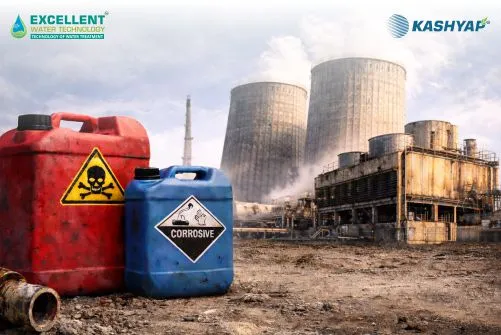
Harmful Effects of Using Chemicals for Chillers & Cooling Towers
Cooling towers keep industries running. But what keeps them running is often what costs the most and harms the most.
Chemical water treatment has been the industry standard for decades, managing scale, corrosion, and biological growth. Yet these chemicals come with a hidden price - workplace hazards, environmental burden, and operational complexity. If you operate large cooling systems, you've likely invested in biocides, corrosion inhibitors, and scale suppressants. But what if there was a way to handle the harmful effects of chemicals in cooling towers without these risks?
This blog explores why chemicals are problematic and introduces the non-chemical treatment pathway forward.
Key Takeaways
✔ The harmful effects of chemicals in cooling towers extend beyond water treatment.
✔ The risks of using chemicals in chillers and cooling towers often surface during abnormal conditions.
✔ Health risks of cooling tower chemicals are an ongoing workplace concern.
✔ Chemical treatment controls symptoms but not root causes.
✔ Safer non-chemical alternatives to water treatment focus on prevention, not suppression.
✔ Reducing chemical use in cooling towers supports both performance and sustainability goals.
Common Chemicals Used in Chillers and Cooling Towers
Water treatment in cooling systems traditionally relies on four chemical categories.
1. Scale inhibitors typically include phosphonates and polyacrylates—keep minerals like calcium and magnesium dissolved so they don't crystallize on heat transfer surfaces.
2.Corrosion inhibitors, including orthophosphate, silicates, and zinc compounds, create protective films on metal surfaces to prevent oxidation and rust.
3. Biocides are the heavy hitters. Oxidizing biocides like chlorine and bromine kill microorganisms directly.
4.Dispersants and polymers suspend solid particles, preventing them from settling and creating fouling deposits.
Harmful Effects of Using Chemicals for Chiller and Cooling Tower
1. For People Working There :
Worker safety is where the chemical cost becomes personal. Health risks of cooling tower chemicals are real and often underestimated. Biocides like glutaraldehyde are classified as toxic. Chronic exposure causes respiratory irritation, dermatological issues, and sensitization reactions. Workers handling corrosion inhibitors face skin contact risks and inhalation hazards during tank maintenance. Chlorine-based biocides can generate toxic byproducts when they react with organic matter in the water, a phenomenon called disinfection byproduct formation.
Even with best practices, accidental exposure remains a workplace risk. The CDC and OSHA track cooling tower chemical incidents annually, and the change is clear: companies are moving toward restricting chemicals rather than managing them better.
One additional concern often overlooked - chemical residue in blowdown water can contaminate groundwater and local water supplies if disposal isn't handled.
2. Impact on Equipment Life :
Chemicals intended to protect your cooling tower paradoxically accelerate its degradation. Risks of using chemicals in chillers and cooling towers are embodied in your metal surfaces first. Biocides themselves are corrosive. Chlorine and bromine, while excellent disinfectants, attack stainless steel, copper, and aluminum, the very materials your cooling tower is made from. Over time, you see pitting, stress corrosion cracking, and accelerated thinning of pipe walls.
Studies show that facilities using heavy chemical programs experience faster equipment degradation, shorter replacement cycles for heat exchanger tubes, and higher unplanned downtime. The National Renewable Energy Laboratory (NREL) documented that chemical-heavy water treatment programs increase equipment lifecycle costs by 15–25% compared to systems with optimized treatment strategies.
3. For Operations of the Organization
The operational burden of chemical management is substantial and often invisible until you calculate it. Your facility must maintain:
✔ Inventory systems track chemical levels, expiration dates, and compatibility matrices.
✔ Dosing equipment - chemical feed pumps, injectors, and metering systems requiring calibration and maintenance.
✔ Lab testing protocols to monitor pH, hardness, conductivity, biocide residuals, and other parameters (typically 2–3 tests per week).
✔ Compliance documentation for local environmental agencies, OSHA, and industry standards.
✔ Training records for staff handling hazardous chemicals.
✔ Waste disposal contracts manage blowdown water, sludge, and spent chemical containers.
At this stage, many teams begin questioning system performance itself, specifically how to calculate cooling tower efficiency when water chemistry is constantly fluctuating, and heat transfer is compromised by hidden fouling.
Chemical dependency makes efficiency harder to measure, not easier.
4. For Environment
This is where the conversation shifts from operational cost to planetary consequence. The harmful effects of chemicals in cooling towers on the environment are measurable and accelerating.
Chemical blowdown from cooling towers represents significant water waste. Traditional chemical programs require frequent water discharge (blowdown cycles) to prevent total dissolved solids (TDS) buildup. A 500-ton cooling tower operating 24/7 can discharge 50,000–100,000 gallons of water monthly—water that carries residual biocides, corrosion inhibitors, and scale suppressants into municipal wastewater systems or directly into rivers.
Wastewater treatment plants aren't designed to completely remove these compounds. Phosphates from scale inhibitors contribute to eutrophication in aquatic ecosystems. Chlorine and bromine residuals persist through conventional treatment, harming aquatic microbial communities. Glutaraldehyde and other non-oxidizing biocides are xenobiotic foreign to natural environmental systems and persist in waterways.
Groundwater contamination is a documented risk. Facilities with inadequate blowdown disposal have left chemical legacies in soil and groundwater. Remediation costs run into millions of dollars.
Regulatory agencies now require environmental impact assessments for facilities with older cooling tower infrastructure.
The U.S. EPA estimates that industrial cooling tower blowdown accounts for approximately 300–500 billion gallons of water discharge annually across the country. That's not just water, it's water laden with chemical residues.
Concerned about chemical exposure and discharge risks? Explore a non-chemical solution that simplifies cooling tower compliance.
A Safer, Non-Chemical Approach to Reducing Chemical Risks in Chillers and Cooling Towers
The alternative exists. It's called Non-Chemical Scale and Bio Removal System technology, which replaces chemical dependency with electrolysis-based water conditioning.
Water passes through a specially designed electrochemical reactor where electrical impulses restructure mineral particles and create oxidative conditions that control biological growth without adding any chemicals to the water. The system accomplishes three things simultaneously:
1. Scale prevention and removal (Studies document that safer alternatives to chemical water treatment, like this, reduce scale formation by 95%+ within 60–90 days of operation)
2. Biological control (The electrical impulses also disrupt microbial cell walls (electroporation), preventing reproduction)
3. Reduced water consumption (60–80% reductions in blowdown water volume)
The system requires no chemical feed pumps, no inventory management, no training, and no disposal contracts. Installation is quick, and operation is automated. Monitoring is simpler; basic water quality testing replaces the complex parameter tracking of chemical systems.
This is the real benefit. No chemical residues enter wastewater streams. No groundwater contamination risk. No contribution to eutrophication or aquatic ecosystem disruption. Your facility's blowdown water contains only minerals, no xenobiotic compounds. In regulated markets (Europe, parts of California), this eliminates future regulatory risk.
Kashyap's Auto-BFSR System exemplifies this approach, a proven non-chemical alternative trusted by enterprises like TATA, Cipla, Adani, and JSW. These aren't small operations adopting experimental technology. They're global corporations that calculated risk and chose zero-chemical operation.
FAQ’s
1. Are chemical-free systems suitable for industrial cooling towers?
Yes. Modern non-chemical systems are designed for high-load industrial applications and work alongside existing infrastructure.
2. Do non-chemical systems completely eliminate scale?
They prevent hard scale adhesion and convert scale into non-fouling forms that are easily removed through normal circulation.
3. Is this approach compliant with environmental regulations?
Yes. Eliminating chemical discharge simplifies compliance and reduces environmental reporting risk.
4. Can chemical and non-chemical systems work together?
Yes, during transition phases or for specific contamination events.
Conclusion
Chemical water treatment solved a real problem 50 years ago. Today, it's a solution creating new problems for your workforce, your equipment, your operations, and the environment.
Kashyap's Non-Chemical Scale and Bio Removal System represents the next evolution. It eliminates the chemical dependency while delivering superior water quality, lower operating costs, reduced water consumption, and zero environmental risk.
Get in touch with our team to evaluate your specific cooling system conditions and see exactly how much you could save your plant and the environment both.
About the author
Vivek Donga is the CEO & Technical Director at Kashyap, a leading water solution company that provides solutions for hard water treatment. With 9+ years of experience in addressing hard water challenges and keeping the customer-centric approach, he is dedicated in delivering eco-friendly and efficient solutions for commercial and industrial applications.