February 18, 2026
14 min
The world is moving away from chemical discharge for hard water issues. Are you?
Hard water does not just stain your pipes. It quietly raises your plant’s cost of production. Every millimeter of scale forces your chillers and boilers to work harder, consume more fuel, and fail sooner. An electronic water conditioner changes this equation not by adding chemicals or wasting water. But by saving your equipment’s design efficiency.
For industries searching for sustainable industrial hard water treatment, this blog highlights an innovation that delivers high performance without any operational complexity. Yes, that's true, let's get started!
✔ Hard water does not just stain pipes; it quietly raises energy bills, forces equipment to fail sooner, and inflates maintenance budgets.
✔ An electronic water conditioner prevents scale without chemicals, salt, maintenance and without a single litre of wastewater.
✔ Kashyap's technology works on any pipe material, PVC, HDPE, steel, or copper, making it the only industrial hard water treatment that adapts to your existing infrastructure.
✔ The choice is simple - keep managing scale with chemicals and labour, or install Kashyap's Anti-Scale System once and increase the life of your equipment.
Hard water in industrial systems primarily causes scale formation, heat transfer loss, energy inefficiency, corrosion acceleration, and rising maintenance costs.
1. Scale Deposition in Heat Exchangers
Calcium and magnesium precipitate under heat. These deposits form a hard insulating layer inside tubes.
What happens after? - Reduced thermal conductivity.
2. Reduced Heat Transfer Efficiency
Scale acts as an insulator. Even thin deposits increase energy demand to maintain output.
3. Increased Power Consumption
Pumps and chillers work harder against restricted flow.
4. Blocked Nozzles & Spray Systems
Cooling towers and process equipment suffer from uneven water distribution.
5. Corrosion Acceleration
Scale deposits create differential aeration zones, increasing localized corrosion.
6. Frequent Shutdowns
Manual cleaning cycles interrupt operations.
7. Higher Chemical Dependency
Continuous dosing becomes the default method of industrial hard water treatment.
Industries/Applications affected include:
✔ Cooling towers
✔ Chillers
✔ Condensers
✔ Boilers
✔ HVAC systems
✔ Food processing plants
✔ Pharmaceutical manufacturing
Hard water is not just a water issue, but is a performance issue!
Manage the scaling issues of industrial hard water with Kashyap Anti-Scale System.
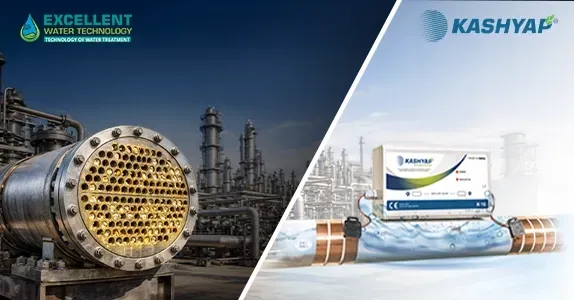
An electronic water conditioner is a non-chemical electronic descaling systemthat uses controlled electromagnetic frequencies to alter the crystallization of dissolved minerals.
It is a frequency-based device typically wrapped around the inlet pipe that alters hardness.
Kashyap’s electronic water descaler system lies in impulse technology that works on any pipe material, PVC, HDPE, copper, stainless steel, or GI. Unlike electromagnetic devices that fail on non-ferrous pipes.
1. Limescale Formation in Heat Exchangers & Boilers
Hard water minerals form a strong scale inside boilers, heat exchangers, and pipelines, reducing heat transfer and increasing fuel consumption.
An Electronic water conditioner alters mineral crystallisation so scale does not adhere to surfaces without using chemicals, salt regeneration, or water wastage.
2. Energy Loss & Reduced Efficiency
Even thin scale deposits act as insulation, forcing systems to consume more power to maintain output.
By preventing hard scale buildup, electronic conditioning maintains thermal efficiency, lowers energy costs, and supports sustainable operations without chemical dosing.
3. Dependence on Chemical Water Treatment
Traditional softeners and anti-scalants require ongoing chemical purchase, handling, discharge management, and regulatory compliance.
Kashyap's solution operates completely chemical-free and lowers recurring operational costs.
4. Pipe Blockage & Reduced Flow Rates
Scale narrows pipe diameter over time, causing pressure drops, pump strain, and uneven water distribution.
By minimising bonded scale formation, electronic conditioning supports smoother flow, protects pumps, and extends equipment lifespan.
Upgrade to a smarter, chemical-free solution and protect your equipment while reducing energy and water consumption.
Find out exactly how Kashyap's electronic water descaling system works🡻
1. Hospitals & Healthcare Infrastructure
Hospitals operate 24/7 HVAC, chilled water systems, and cooling towers. Scale in these systems increases energy load and risks operational disruption.
A water conditioner for industrial hard water helps maintain thermal efficiency without introducing additional chemicals into sensitive environments.
2. Hotels & Resorts
Large hospitality properties rely heavily on centralised cooling and hot water circulation. Hard water scaling increases boiler inefficiency and shortens equipment life.
An electronic water descaler supports long-term system stability while reducing frequent descaling cycles.
3. Tech Parks & Commercial Complexes
Multi-building infrastructures operate shared HVAC plants. Even minor scale formation reduces overall energy performance across the facility.
An electronic descaling system becomes part of the energy management strategy, not just water treatment.
4. Data Centres
Data centres depend on precise temperature control. Scale buildup inside condenser tubes or cooling loops directly impacts cooling reliability.
A chemical-free industrial hard water treatment approach ensures efficiency without introducing contaminants into controlled environments.
5. Shopping Malls & Large Retail Spaces
High occupancy means heavy HVAC load. Continuous operation increases scaling risk. A hard water solution for industries in such environments focuses on protecting chillers, cooling towers, and heat exchangers.
6. District Cooling Plants
Large-capacity cooling plants operate having scaling issues all the time.
Even small heat transfer inefficiencies multiply across megawatt-level systems. An electronic water descaler system supports scaling control without chemical complexity across distributed infrastructure.
7. Airports
Airports operate massive HVAC networks, central cooling, and continuous circulation systems.
Frequent shutdowns are not an option. A preventive water descaling system ensures uninterrupted performance.
8. Pharmaceutical Manufacturing
Pharma environments demand precision, compliance, and minimal chemical interference. An electronic water conditioner provides scale prevention without affecting water chemistry parameters critical for process stability.
9. Food Processing Units
Heat exchangers, pasteurisers, and cooling systems are sensitive to scale buildup. Even thin mineral deposits reduce process efficiency.
A chemical-free industrial hard-water treatment strategy aligns with hygiene and regulatory expectations.
10. Refineries & Heavy Industrial Plants
High-temperature operations accelerate scale formation.
An engineered electronic water descaler protects condensers, cooling loops, and pipelines from heavy mineral deposition.
11. Cold Storage Facilities
Temperature control stability is essential. Scaling in refrigeration systems increases compressor workload and electricity consumption.
A stable water conditioner for industrial hard water protects operational efficiency over long cycles.
12. Injection Moulding & Process Manufacturing
Mould cooling systems require consistent heat removal. Scale reduces mould cooling efficiency and impacts production cycle time.
A reliable electronic descaling system supports consistent manufacturing output.
Operating a large facility and ready to eliminate scale without chemicals?
1. Restores Equipment Efficiency
Kashyap does not just prevent a new scale. It gradually removes existing deposits. Your chillers return to their OEM-specified heat transfer coefficients.
2. Zero Water Wastage
Traditional softeners waste 50–100 liters of water for every 1000 liters treated. An electronic water conditioner wastes zero.
3. Chemical Free
Our anti-scale system (electronic water conditioner) does not add salt, sodium, acids, or any form of chemical to the water. Instead, it works by changing the physical characteristics of hardness crystals so they lose their ability to firmly attach to pipe surfaces and heat exchangers.
The system is installed externally and does not come into direct contact with the water. An electronic unit generates controlled electric impulses, managed by a microprocessor.
4. Energy Saving
It eliminates insulating scale buildup on heating elements, allowing water heaters to operate more efficiently and significantly reducing the energy required to heat your water.
5. Economic & Environmental Benefits
A 2020 study in the Journal of Cleaner Production confirmed that electrochemical descaling offers significant economic and environmental advantages over chemical scale inhibitors.
Kashyap's innovation is not just a sustainable product, but it is a commercially smarter decision too.
6. Works on Any Pipe
Water softener vs. water descaler debates often revolve around material compatibility. Kashyap's anti-scale system eliminates that objection. PVC. HDPE. Steel. Copper. It does not matter.
An electronic water descaler modifies minerals. A softener removes minerals using ion exchange.
Water Softener:
✔ Uses salt
✔ Requires regeneration
✔ Produces wastewater
✔ Higher maintenance
✔ Ongoing chemical cost
Electronic Water Descaler:
✔ No salt
✔ No chemical regeneration
✔ No water wastage
✔ Minimal maintenance
For industries prioritising scale prevention without altering water composition, an electronic water descaler system becomes the strategic choice.
Choose prevention over regeneration cycles.
1. What is an electronic water conditioner, and how does it work?
An electronic water conditioner uses electromagnetic signals to alter mineral crystallization, preventing scale adhesion inside pipes without removing minerals or adding chemicals.
2. How effective are electronic water descalers for industrial hard water problems?
A well-designed electronic water descaler reduces new scale formation, supports gradual deposit reduction, and improves heat transfer efficiency in industrial systems.
3. Are electronic water conditioners better than chemical water treatment for industries?
Yes. For many industrial applications, electronic water conditioners are often a better choice than chemical treatment due to their lower environmental impact and operational costs
4. Do electronic water conditioners work on existing scale buildup?
Yes. Over time, treated minerals gradually weaken and reduce existing deposits, assisting in condenser scale removal and pipeline cleaning.
5. How much maintenance does an electronic water conditioner require?
Minimal. An electronic descaling system operates externally with no regeneration or chemical refill.
If your operations depend on cooling towers, chillers, condensers, HVAC systems, or process heat exchangers, scale is already affecting your performance.
And if you are still relying only on chemicals for industrial hard water treatment, you are managing symptoms, not solving the cause.
Kashyap’s electronic water conditioner is engineered specifically for industrial environments where:
✔ Heat transfer efficiency must remain stable
✔ Downtime is expensive
✔ Maintenance cycles are frequent
✔ Chemical dependency is increasing operational costs

Get a Quote
Are you interested in our solutions?
Please feel free to contact me directly

Vivek Donga
CEO & Director (Technical)
Response within 24 hours
Mon-Fri 9:00 - 17:00