Data Centre Non-Chemical Water Treatment System: A Complete Guide

Vivek Donga

March 20, 2026

18 min

Table of Contents

Introduction

blog image

If you manage a data centre, you already know that cooling is one of your biggest operational expenses.

But here is a number that might surprise you - A typical 100MW hyperscale facility can require around 2 million litres of water per day just for cooling.

Traditionally, managing that much water quality meant buying drums of chemicals, constantly testing, and hoping the dosage was right. But there is another way. The industry is finally moving away from reactive chemical fixes toward proactive, physical solutions.

This blog explores why chemical-free water treatment for data centers is becoming the standard for facilities that want to lower costs, reduce downtime, and reach their sustainability targets without compromising on performance.

Key Takeaways

Data centres are rapidly moving from chemical to non-chemical water treatment for data centres due to regulatory, cost, and sustainability pressures.

Technologies like electromagnetic waves and vortex cavitation physically alter water properties to prevent scale, stop corrosion, and control bacteria without additives.

Despite higher initial costs, the ROI is attractive, with payback periods often under three years due to savings in energy, water, and maintenance.

Adopting these systems helps data centres meet strict ESG goals, secure certifications, and reduce dependency on chemical supply chains.

Why Data Centres Are Moving Away from Chemical Water Treatment

For decades, dumping chemicals into cooling towers was the standard. It worked, but it came with baggage. Today, the move toward non-chemical water treatment for data centres is driven by three major pressures.

Environmental & Regulatory Drivers

Chemicals harm rivers and aquifers when you blow down water. Stricter regulations push for zero discharge, and chemical-free water treatment for data centers avoids fines while cutting the harmful effects of using chemicals. It recycles water onsite, easing pressure on local supplies.

Operational Cost Concerns

Chemicals cost money, not just the price of the drum, but the labour to handle it, the safety for staff, and the corrosion damage if you overdose. Chemical programs often require continuous monitoring and adjustment. Miss the dosage, and you risk the scale. Overdose, and you are consuming your profits.

Sustainability Goals

Every data centre today has a sustainability report. Whether it is ESG goals or carbon neutrality, water usage effectiveness (WUE) is a key metric. Switching to a chemical-free water treatment for data centers instantly reduces the chemical footprint and helps in achieving certifications like LEED.

Common Cooling Water Problems in Data Centres

Before we get into the solution, let’s look at the issues inside your cooling system:

1. Scale: Hard water minerals (calcium carbonate) deposit on heat exchange surfaces. This acts like an insulator, making your system work harder and consume more energy.

2. Corrosion: Oxygen and aggressive ions eat away at metal pipes, leading to leaks and expensive downtime.

3. Biological Growth (Legionella): Warm, stagnant water is a breeding ground for bacteria. Preventing legionella growth is not just a maintenance task; it is a public health responsibility.

4. Fouling: Dirt and suspended solids settle in the tower, reducing efficiency.

What is a Non-Chemical Water Treatment System?

Simply put, it is a technology that conditions water without adding liquid or solid chemicals. Instead of altering the water chemistry by adding inhibitors, these systems change the behaviour of the minerals and microbes using physics.

The goal of a chemical-free water treatment for a data centre remains the same as chemical treatment: control scale, kill bacteria, and stop corrosion. But the method is entirely different.

How Non-Chemical Water Treatment Works in Data Centre Cooling Systems

Step 1: Water Circulation

Water circulates through the cooling system, absorbing heat from the servers via chillers or heat exchangers.

Step 2: Physical Conditioning

As the water passes through the treatment device (installed on the main line or in the tower basin), it is exposed to electromagnetic waves or cavitation fields.

For Scale: The energy targets the calcium and bicarbonate ions. Instead of sticking to pipes as hard calcite, they precipitate out as fine, non-adherent aragonite powder that simply washes away during blowdown.

For Corrosion: Some advanced systems, like those using pulsed electromagnetic waves, encourage the formation of a dense magnetite (Fe3O4) layer on pipe surfaces. This layer protects the metal like a shield.

For Bacteria: The treatment disrupts the metabolism of microbes, slowing their reproduction and preventing biofilm formation.

Step 3: Increased Cycles of Concentration

Because the water is conditioned and minerals are less likely to scale, you can run the water longer. This means less blowdown (wastewater) and significant water saving tips in action.

Step 4: Automated Monitoring

Modern systems come with IoT-enabled sensors that monitor conductivity, pH, and temperature, adjusting the treatment in real-time.

Types of Non-Chemical Technologies :

1. Electromagnetic Water Conditioning: Uses specific frequency waves to alter the behaviour of dissolved minerals.

2. Electrolytic Treatment: Uses electric currents to create reactions that prevent corrosion and kill bacteria.

3. Physical Water Treatment: Includes vortex or cavitation methods that change the physical structure of the water.

Still relying on chemicals to manage cooling water in your data centre?

Performance Comparison: Non-Chemical vs Chemical Treatment Systems

Choosing between chemical and non-chemical is about choosing the outcome that matters most to your facility.

If you use chemicals, you are essentially managing a continuous process. You buy drums, store them safely, test the water weekly, and adjust dosages. The water quality is dependent on human accuracy and supply chains. The result? Effective, but high-maintenance and risky for the environment.

If you use a non-chemical system, you are investing in an asset. You install it, and it works 24/7 without running out of supply. There is no variation in dosage because there is no dosage. It handles scale and bacteria at the source. The result? Consistent water quality, zero chemical handling, and lower long-term costs (saves planet too).

Benefits of Non-Chemical Water Treatment for Data Centres

Zero Chemical Discharge

When you treat water with biocides and inhibitors, that water eventually has to go somewhere. Typically, it goes down the drain. That means you are discharging toxic or chemically active water into the municipal system. With a non-chemical system, there is nothing to discharge. The water is physically conditioned. This eliminates the risk of fines and the administrative burden of reporting hazardous waste.

Water Conservation

Because non-chemical systems prevent scale so effectively, you can run your cooling water longer. In technical terms, you increase the "cycles of concentration." Instead of dumping water because the mineral content is too high, you keep it circulating. This directly leads to less fresh water intake.

The End of Chemical Usage

Think about the entire supply chain for chemicals. You have to order them, pay for shipping, store them in a safe, bonded area, and train staff on how to handle chemicals. All of that costs money. A drum of biocide might only cost a few hundred dollars, but the logistical overhead doubles or triples that number. A non-chemical system removes that line item from your budget entirely. Forever!

Energy Efficiency Through Clean Heat Transfer

Scale is an insulator. Even a paper-thin layer of calcium carbonate on a heat exchanger surface acts like a blanket. It forces your chiller to work harder and run longer to shed the same amount of heat. By keeping heat transfer surfaces spotless, a chemical-free water treatment for data centers ensures that every kilowatt of energy you pay for goes toward cooling the servers, not fighting through a layer of rock. This can shave 5-10% off your cooling energy bill.

Lower Maintenance Labour

Chemical systems require constant monitoring. You test the water, you adjust the feed, you clean the nozzles where scale builds up anyway. With a physical system, the maintenance drops to near zero. You are not removing the sludge from the tower basin every month. You are not replacing corroded pipes. Your maintenance team can focus on critical infrastructure instead of playing chemist.

Environment Friendly

A truly chemical-free water treatment for data centers means your operation has no chemical footprint whatsoever.

When you install a non-chemical system, your cooling tower interacts with the environment exactly as rainwater would. The water you return to the hydrological cycle is free from industrial pollutants. For data centres located in sensitive ecological areas or near residential zones, this is a massive win for community relations and corporate responsibility!

ROI & Cost Analysis

Before we calculate the savings, we need to understand what you are actually spending on chemicals right now.

Direct Chemical Costs:

The price of biocides, corrosion inhibitors, scale inhibitors, and dispersants. For a medium to large data centre, this can easily run into tens of thousands of dollars per year. And unlike a piece of equipment, you get no asset at the end of the year.

Hidden Labour Costs:

Who manages your chemical program? Someone on your team has to test the water, adjust the chemical feed pumps, calibrate controllers, and refill drums. If you are using an external water treatment consultant, you are paying for their visits, too. This is labour that could be spent on actual infrastructure improvement.

Safety & Compliance Overhead:

Storing hazardous chemicals requires special containment areas, safety signage, and staff training. You need PPE (personal protective equipment) for anyone who handles the drums. You need to document everything for environmental audits. All of this has a cost, either in direct expenses or in administrative hours.

The Cost of Inefficiency:

This is the highest hidden cost. Chemical programs are reactive. Scale still builds up, just slower. Corrosion still happens. Every bit of scale on your heat exchangers forces your chillers to work harder. A 1mm layer of scale can increase energy consumption by as much as 7-10%. That wasted energy shows up on your utility bill every single month, and you probably blame it on the weather instead of the water.

Want to eliminate recurring chemical costs in your cooling system?

The Investment: What You Pay For a Non-Chemical System

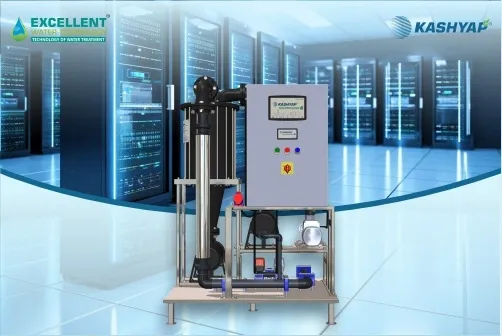
A chemical-free water treatment for data center systems is a capital investment. You are purchasing a system that control units, electromagnetic coils, cavitation chambers, and monitoring sensors.

Initial Cost: This varies based on the size of your cooling system, the number of cooling towers, and the flow rate. It includes the equipment, professional installation, and commissioning.

Operating Cost: This is where the magic happens. The operating cost is primarily the electricity to run the control unit (often less than a light bulb) and minimal routine checks.

When you look at a data centre non-chemical water treatment system through the lens of Total Cost of Ownership, the financial argument is clear. It transforms a high-maintenance, recurring operational expense (chemicals) into a stable, long-term asset that reduces costs, saves energy, and protects your critical equipment. The payback is predictable, and the long-term savings are undeniable.

Challenges & Limitations

When Chemical Treatment Might Still Be Needed

There are specific water conditions where a physical system alone may not be enough. If your makeup water source is heavily contaminated with industrial pollutants, oils, or extremely high levels of dissolved solids, you might need a hybrid approach. In some cases, a little chemistry acts as a "polishing" step after the physical treatment.

Water Quality Variability

Not all water is created equal. If your data centre pulls water from a municipal supply, the quality can change seasonally. In spring, you might get more runoff and sediment. In summer, higher mineral concentration.

Non-chemical systems are designed to handle typical variations, but extreme swings can challenge them. For instance, if your source water suddenly spikes in hardness, the system needs time to adjust. This is why continuous monitoring is critical.

Space and Retrofitting Constraints

Installing a new system in an existing data centre is not always plug-and-play. Some technologies require specific pipe configurations, access for maintenance, or space for control panels. In a crowded mechanical room where every square inch is already used, retrofitting can be a puzzle.

However, many modern systems are designed with modular, compact footprints to address this exact issue. It is rarely a dealbreaker, but it is a logistical step that requires planning.

Common Misconceptions to Clear Up

"It's just a magnet." - Modern systems use sophisticated frequency generators, pulsed electromagnetic waves, and electronic controllers. They are not magnets; they are engineered devices.

"It works instantly." Physical conditioning often needs a short "conditioning period" to establish protective layers on pipe surfaces. You might not see 100% results on day one, but over weeks, the system stabilizes.

"It removes all minerals." No. It changes the behaviour of minerals so they don't stick. The water still contains minerals; they just don't form a hard scale.

Future Trends in Data Centre Water Treatment

Waste Heat as a Resource

Here is a best development: what if the heat your data centre produces could make water?

Companies like Gneuton are pioneering technology that uses the waste heat from gas turbines or backup generators to purify water. Think about that. Instead of dumping heat into the atmosphere, you use it to distill contaminated water industrial wastewater, brackish water, even oilfield produced water into clean, distilled water for cooling. This turns a data centre from a water consumer into a potential water producer. It is an early stage, but pilots are coming online in 2026.

AI-Powered Monitoring and Predictive Control

We talk about AI in servers, but AI is coming to water treatment, too.

Future systems will use real-time data and predictive analytics to anticipate water quality changes before they happen. Imagine a system that knows a storm is coming, predicts the shift in source water quality, and adjusts treatment parameters automatically, all without human intervention. This level of intelligence will optimize energy use, chemical elimination, and equipment protection simultaneously.

On-Site Generation of Treatment Agents

A fascinating trend is the move to generate treatment chemicals on-site, on-demand, rather than shipping them in. HPNow's GOgen technology, for example, produces hydrogen peroxide from only water and electricity right at the facility. This eliminates the safety risks of transporting and storing hazardous chemicals, while still providing a powerful oxidizer when needed. It then breaks down into harmless water and oxygen after use. This is a hybrid approach that keeps the benefits of oxidation without the baggage of chemical logistics.

Stricter Regulation Driving Adoption

Governments are running out of patience with industrial water waste. In Europe, directives around industrial emissions and water discharge are tightening. In the US, communities are pushing back against data centres that threaten local water supplies, Google even withdrew a $1 billion proposal in Indiana after resident concerns.

Ready to reduce chemical dependency and improve cooling efficiency?

FAQs

1. How much water do data centres use?

A large hyperscale facility can use millions of litres per day, depending on climate and cooling technology.

2. What is the cost difference between chemical and non-chemical systems?

Chemicals have a low entry cost but high recurring costs. Non-chemical systems have a higher upfront cost but lower operational expenses, with payback typically under 3 years.

3. How long do non-chemical systems last?

Quality systems can last 10-15 years with minimal maintenance, usually just sensor calibration and electronic checks.

4. Do non-chemical systems work in all climates?

Yes. Whether you are in a hot, arid region like the Middle East or a temperate climate, physical water treatment adapts to the water chemistry, not the weather.

5. What maintenance is required?

Routine checks of the control unit and cleaning of sensor probes. No handling of hazardous materials.

6. Are there any regulatory approvals needed?

Switching to non-chemical often reduces regulatory burden because you are no longer discharging chemical waste.

7. Why are data centres switching to chemical-free water treatment?

To reduce operational costs, meet sustainability goals, and simplify compliance while improving equipment lifespan.

8. What problems can untreated cooling water cause in data centres?

Scale, corrosion, and preventing Legionella growth failures are the biggest risks. These lead to downtime, which is the most expensive problem a data centre can face.

Conclusion

With our Excellent Water Technology, we have understood that the cooling tower is the heartbeat of your facility. Our approach to chemical-free water treatment for data centers is not just about removing chemicals; it's about adding reliability. We focus on delivering measurable outcomes by giving cleaner pipes, lower energy bills, and zero environmental impact.

If you are looking for a partner who understands the science of water and the business of data centres, you know where to find us.

About the author

Vivek Donga

Vivek Donga is the CEO & Technical Director at Kashyap, a leading water solution company that provides solutions for hard water treatment. With 9+ years of experience in addressing hard water challenges and keeping the customer-centric approach, he is dedicated in delivering eco-friendly and efficient solutions for commercial and industrial applications.

Vivek Donga

CEO & Technical Director

Contact our specialists now
Head Image

Get a Quote

Are you interested in our solutions?

India flag

(+91)

Please feel free to contact me directly

Image of head

Vivek Donga

CEO & Director (Technical)

info@ewt-kashyap.com
+91 97254 40807