Understanding Different Types of Cooling Towers

Vivek Donga

April 1, 2026

17 min

Table of Contents

Introduction

https://images.ewt-kashyap.com/blogs/Understanding-The-Different-Types-of-Cooling-Towers/Understanding-The-Different-Types-of-Cooling-Towers

A cooling tower is a heat-rejection device that cools process water by bringing it into contact with air. In most industrial setups, it removes heat that would otherwise overheat equipment or slow production.

Cooling towers matter because they keep chillers, heat exchangers, and entire plants operating at peak performance. Without them, energy consumption increases, and equipment fails sooner. They also help industries meet water-conservation targets and lower carbon footprints.

Different types of cooling towers exist depending on the airflow method, water-to-air contact, and heat-transfer principle. Some rely on evaporation for maximum cooling; others use air alone for zero water loss. The next sections of this blog will explain each one of them, so you can decide what fits your operation.

Key Takeaways

Cooling towers remove heat from industrial water systems through air-water heat exchange.

The most common cooling tower types include evaporative, dry, mechanical draft, natural draft, and hybrid towers.

Induced draft evaporative towers are typically the most efficient industrial cooling systems.

Cooling tower efficiency depends heavily on water quality and scale control.

Biofouling and scaling reduce heat transfer efficiency and increase energy consumption.

Chemical-free water treatment technologies like Kashyap's AUTO BFSR help maintain cooling tower performance.

Proper cooling tower selection and maintenance improve energy efficiency and equipment lifespan.

What is a Cooling Tower?

A cooling tower is a heat-rejection device that removes excess heat from circulating water by transferring it to the atmosphere.

Cooling towers are widely used in industries where equipment generates large amounts of heat — including power plants, HVAC systems, chemical processing, and manufacturing.

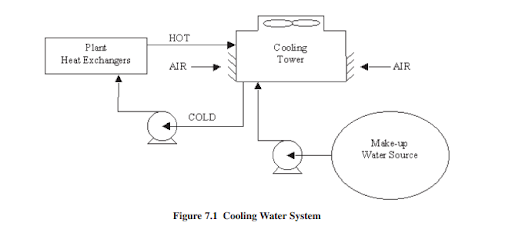
https://images.ewt-kashyap.com/blogs/Understanding-The-Different-Types-of-Cooling-Towers/Cooling-tower-system

                                           Source

The basic function of a cooling tower is simple:

Hot water from industrial equipment enters the tower.

The water is distributed over a large surface area.

Air flows through the tower.

Heat transfers from water to air.

The cooled water returns to the process.

A small portion of the water evaporates during this process, removing heat from the remaining water.

Evaporative cooling occurs when a small fraction of water evaporates and absorbs heat energy from the remaining water, lowering its temperature. This mechanism allows cooling towers to reduce water temperature close to the wet-bulb temperature of the surrounding air.

The higher the contact between water droplets and airflow, the more efficient the cooling process becomes.

Key components include:

Hot-water distribution system (spreads water evenly)

Fill material (increases surface area for contact)

Drift eliminators (catch water droplets before they escape)

Cold-water basin (collects cooled water)

Fans or natural draft chimney (moves air)

These parts work together to reject heat reliably day after day.

Types of Cooling Towers

Cooling towers are classified based on heat transfer mechanism, airflow design, and water circulation method.

Below are the most commonly used cooling tower types.

1. Evaporative Cooling Towers

Evaporative towers operate using direct contact between air and water.

Hot water is sprayed inside the tower while air flows across it. A small portion of water evaporates and removes heat from the remaining water.

These are the most widely used industrial cooling towers because they provide high thermal efficiency.

Common examples include:

Counterflow towers

Crossflow towers

Mechanical draft towers

2. Non-Evaporative (Dry) Cooling Towers

Dry cooling towers use air-cooled heat exchangers instead of evaporation.

Water flows inside tubes while air moves across the outside surfaces to remove heat.

Advantages:

Minimal water consumption

Reduced drift losses

Lower risk of contamination

However, dry towers generally provide lower cooling efficiency compared to evaporative towers.

3. Natural Draft Cooling Towers

These towers rely on natural convection to move air through the structure.

The tall hyperbolic design allows hot air to rise naturally and pull cooler air from the bottom.

Natural draft towers are commonly used in:

Thermal power plants

Nuclear plants

Large-scale industrial operations

4. Mechanical Draft Cooling Towers

Mechanical draft towers use fans to control airflow through the system.

They are the most common industrial cooling towers because airflow can be regulated to maintain consistent cooling performance.

Two major types include:

Forced Draft Cooling Tower

Fans at the base push air through the tower.

Induced Draft Cooling Tower

Fans at the top pull air upward through the tower.

Induced draft towers are generally more efficient because they prevent heat recirculation.

5. Hybrid Cooling Towers

Hybrid towers combine dry and wet cooling methods.

They operate in dry mode during cooler conditions and switch to evaporative cooling when additional cooling is required.

Hybrid systems help industries balance water consumption and cooling efficiency.

Discover non-chemical ways to maintain cooling tower performance.


Comparison of Cooling Tower Types

Cooling tower typeCooling efficiency Water use MaintenanceTypical applications
Evaporative TowersVery highModerateMediumPower plants, petrochemicals
Dry Cooling TowersMediumVery lowLowWater-scarce regions
Mechanical DraftHighModerateMediumHVAC, industrial plants
Natural DraftHighHighLowPower generation
Hybrid TowersHighOptimizedMediumSustainable industrial systems

Water treatment needs also differ - evaporative towers face more scaling and biofouling risk, while dry towers stay cleaner but still benefit from protection against corrosion.

Which Cooling Tower is More Efficient?

Evaporative towers usually win on efficiency because they reach closer to the wet-bulb temperature, delivering more cooling per unit of energy in moderate to warm climates. Dry towers shine when water is scarce or temperatures drop, but they need more fan power to achieve the same cooling.

Efficiency ultimately depends on your location, heat load, water availability, and operating hours, not a one-size-fits-all answer.

How to choose the right cooling tower

Start with your needs:

Heat rejection load and desired outlet temperature

Available water supply and discharge limits

Local climate (wet-bulb temperature matters)

Space and noise restrictions

Budget for installation plus long-term water and energy costs

Factor in maintenance access and future expansion. The goal is a system that delivers reliable cooling while keeping total ownership costs low.

Design is not killing your efficiency - scale and biofouling are.


How Can I Make My Cooling Tower More Efficient?

The most effective way to improve cooling tower efficiency is to control scaling, corrosion, and biofouling inside the water circulation system.

Even small deposits of scale can significantly reduce heat transfer efficiency.

Kashyap's Auto-BFSR is a non-chemical water treatment approach that delivers measurable results without chemicals, maintenance, and commitment. Using electrolysis technology, it changes the structure of scale-forming minerals so they wash away instead of sticking. At the same time, it also solves common problems of cooling tower & stops microorganisms from forming slimy films.

The direct outcomes are :

Up to 80% reduction in blow-down and makeup water

100% savings on chemical costs

Improved heat transfer and lower energy bills

Extended equipment life with zero maintenance on the treatment unit

Prevention of Legionella risk through better water quality

Whether you run an evaporative or non-evaporative tower, this non-chemical approach keeps surfaces clean, raises cycles of concentration safely, and controls rising hot air release.

Save water & energy in your cooling tower.


Common Applications of Cooling Towers

1. Power Generation Plants

Power plants are among the largest users of cooling towers. In thermal and nuclear power stations, steam turbines generate electricity, and after passing through the turbine, the steam must be condensed back into water to restart the cycle.

Cooling towers remove heat from condenser water so the system can operate continuously and efficiently. These systems operate on a massive scale, power plants also focus heavily on ways to maintain cooling towers to prevent scale formation, corrosion, and biofouling that could reduce heat transfer efficiency.

2. HVAC Systems for Large Buildings

Large commercial buildings rely on cooling towers as part of their HVAC infrastructure. Facilities such as hospitals, airports, universities, shopping malls, and hotels use chillers to cool indoor spaces.

Cooling towers help remove the heat rejected by these chillers and release it into the atmosphere. In modern building management systems, operators increasingly implement water-saving tips for efficient cooling towers, such as optimized blowdown cycles and improved water treatment, to reduce water consumption and operating costs.

3. Petrochemical and Oil Refineries

Petrochemical plants and oil refineries generate enormous heat during refining, distillation, and chemical processing.

Cooling towers regulate temperatures across multiple systems, including:

Condensers

Heat exchangers

Compressors

Chemical reactors

4. Manufacturing Industries

Many manufacturing sectors depend on cooling towers to maintain consistent production temperatures.

For example:

Steel and Metal Processing

Steel rolling mills generate extreme heat during metal shaping processes. Cooling towers help stabilize equipment temperatures and protect machinery.

Plastic and Injection Molding

Plastic injection molding requires rapid cooling to solidify molded components and maintain production speed.

Automotive Manufacturing

Cooling towers support welding systems, machine cooling, and paint processes.

In these industries, efficient water circulation combined with water-saving tips for efficient cooling towers helps companies manage both operational costs and environmental impact.

5. Data Centers

Data centers house thousands of servers that generate significant heat during continuous operation.

Cooling towers are often integrated with chiller systems to maintain the strict temperature conditions required for reliable server performance.

6. Chemical and Pharmaceutical Industries

Chemical manufacturing involves reactions that produce large amounts of heat. Cooling towers are used to regulate temperatures in reactors, condensers, and distillation columns.

Temperature stability is essential for maintaining product quality and safe operations.

7. District Cooling Systems

District cooling systems supply chilled water from a central plant to multiple buildings within an urban area, commercial complex, or industrial park.

Cooling towers in these systems remove heat from the central plant, allowing chilled water to circulate efficiently across the network.

FAQs

1. How do I choose the right cooling tower?

Consider cooling capacity, water availability, climate conditions, space constraints, and maintenance requirements before selecting a cooling tower design.

2. Where are cooling towers commonly used?

Cooling towers are widely used in power plants, HVAC systems, petrochemical industries, manufacturing plants, and data centers.

3. Which cooling tower is most efficient?

Induced draft evaporative cooling towers are generally the most efficient because they provide better airflow distribution and higher heat rejection capacity.

Conclusion

From understanding basic principles to comparing evaporative and non-evaporative designs, you now have the clarity needed to select the cooling tower that truly serves your operation. The right choice plus consistent performance comes down to keeping surfaces clean and heat transfer high.

At Excellent Water Technology, we help industries achieve exactly that. Kashyap's Auto-BFSR systems eliminate chemical dependency, slash water and energy waste, and deliver measurable savings that last for years. No matter if you’re optimizing an existing tower or planning a new installation, we’re here to support your efficiency goals with proven, non-chemical solutions.

About the author

Vivek Donga

Vivek Donga is the CEO & Technical Director at Kashyap, a leading water solution company that provides solutions for hard water treatment. With 9+ years of experience in addressing hard water challenges and keeping the customer-centric approach, he is dedicated in delivering eco-friendly and efficient solutions for commercial and industrial applications.

Vivek Donga

CEO & Technical Director

Contact our specialists now
Head Image

Get a Quote

Are you interested in our solutions?

India flag

(+91)

Please feel free to contact me directly

Image of head

Vivek Donga

CEO & Director (Technical)

info@ewt-kashyap.com
+91 97254 40807